A bridge is a cable structure in most cases. Whether it is a suspension bridge, a cable-stayed bridge, a pedestrian bridge, or a temporary works platform, the load path runs through steel cables. If the cable is wrong, the bridge is wrong.
Bridge wire rope covers several distinct duties, and each one needs its own construction: main cables, hangers, stays, catwalk ropes, handrail cables, and erection ropes. We select each one by load, span, fatigue demand, environment, and the standard the project must satisfy.
When people write to us about bridge rope, they often ask for “the rope used on the big suspension bridges.” That is not one product. A main cable and a handrail cable are decades apart in engineering terms, and they should never be specified from the same catalogue line.
What Are the Different Types of Wire Rope Used in Bridges?
Bridge engineers talk about cables by function, not by construction. Getting these functions straight is the first step to a correct order.
We supply bridge wire rope for six main functions: main cables carrying the deck weight, hangers suspending the deck from the main cable, stays carrying the deck to the towers, catwalk ropes forming the temporary working platform, handrail cables for pedestrian protection, and erection ropes used during construction.
| Bridge rope function | Where it sits | What it must do | Typical product |
|---|---|---|---|
| Main cable | Over the towers, from anchor to anchor | Carries the whole deck through vertical hangers | Spiral strand, parallel wire strand, or locked coil |
| Hanger | Vertical, from deck to main cable | Transfers deck load upward | Spiral strand or full locked cable |
| Stay | Diagonal, from tower to deck | Resists deck load through tension | Spiral strand, parallel wire, or locked coil |
| Catwalk rope | Temporary, along the main cable line | Supports workers and equipment during erection | 6X36WS and similar construction rope |
| Handrail cable | Along deck and access walkways | Protects pedestrians, carries local load | Full locked cable or spiral strand |
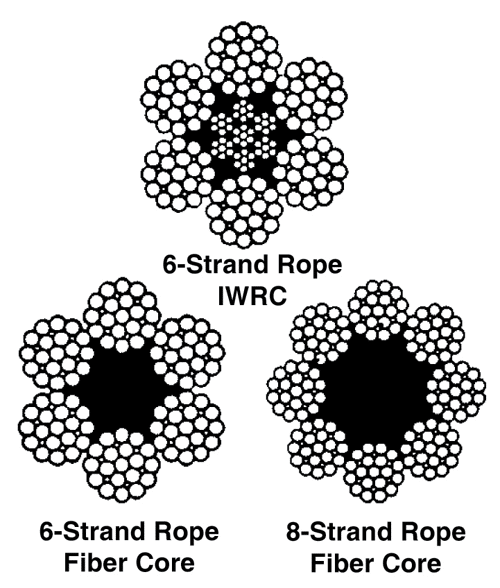
| Erection rope | Temporary, during construction | Pulls segments, lifts equipment, holds the catwalk | 6X36WS, 35WXK7, 8-strand compacted |
Each row in that table has a different failure consequence. A failed erection rope delays a project. A failed handrail cable is a liability. A failed main cable is a structural event.
What Is the Difference Between a Spiral Strand and a Full Locked Cable in a Bridge?
This is the most common question we get about bridge rope, and the answer comes down to the outer surface.
We use a spiral strand when the project needs a high metallic cross-section, high stiffness, and a proven structural cable section, and we use a full locked cable when the project also needs a smooth, nearly sealed outer surface that clamps evenly under saddles and can carry an external sheath. Both are legitimate structural cables. They are not interchangeable.
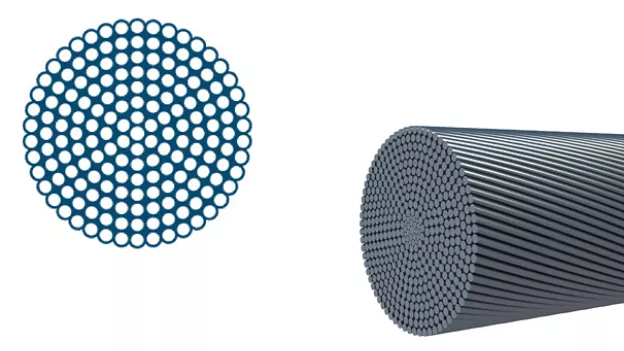
A spiral strand is built from round wires laid in concentric layers with alternating lay direction. The outer surface stays open, with gaps between the round wires. Those gaps are an advantage for weight and cost, and a disadvantage for sealing and for surface protection.
A full locked cable replaces the outer round wires with interlocking Z-shaped wires. The outer surface becomes almost continuous. There are far fewer open spaces for water and debris to enter, and the surface grips evenly under a clamp or saddle.
| Property | Spiral strand | Full locked cable |
|---|---|---|
| Outer wire shape | Round | Interlocking Z-shaped |
| Outer surface | Open, gaps between wires | Nearly closed and smooth |
| Typical design modulus | 150 GPa, prestretched | 170 GPa |
| Metallic cross-section | Very high for the diameter | High, from compacted outer layer |
| Sheath or coating | Common, applied over the strand | Optional, applied over the locked surface |
| Clamping under saddle | Good, but the round wires bear on the saddle | Very even, the locked surface spreads pressure |
| Entrance of water and debris | Possible through the outer gaps | Greatly reduced |
| Common use in bridges | Main cables, hangers, stays | Handrails, deck edge cables, protective and architectural cables |
We also supply parallel wire strand for projects that specify the classic suspender-rope form. It is worth noting that spiral strand and parallel wire strand have similar behaviour under load, so the decision often comes down to the anchorage detail and the local standard rather than the physics.
How Do You Select the Main Cable for a Suspension Bridge?
The main cable is the structural heart of a suspension bridge. It carries the entire dead load of the deck plus the live load of traffic, through the hangers.
We select the main cable by working from the total tension in the cable at the tower saddle, then dividing by the design safety factor, then choosing a construction and diameter that deliver that breaking load with the required stiffness and fatigue life. We confirm the result against the governing code before we cut a single wire.
Three parameters drive the decision and they interact with each other.
Breaking Load
The main cable must carry the factored tension with the safety factor required by the code. For a long-span suspension bridge, this usually means a very large metallic cross-section. The diameter then follows from the available construction and the required strength grade.
Stiffness
Stiffness controls how much the cable stretches under load and how the geometry of the deck behaves under traffic. Structural cables for bridges are usually prestretched before delivery, so the constructional stretch is removed and the cable behaves predictably from the day it is installed.
We prestretch in our own plant before dispatch, and we record it in the delivery documents.
Fatigue
A main cable in a suspension bridge carries a large average load and also millions of small stress cycles from wind and traffic. In many cases the fatigue demand, not the static strength, sets the cable design. This is where the wire-to-wire contact detail and the lay length matter.
We work to EN 12385-10 for the strand, EN 1993-1-11 for the design values, and EN 13411-4 for the terminations. For American projects we can supply to ASTM A586.
How Do You Design Hangers and Stays?
Hangers and stays look similar and behave very differently.
We use spiral strand for hangers because they are long, individually adjustable, and must accept small movements without bending fatigue at the socket, and we use spiral strand or locked coil for stays because they are shorter, carry higher tension, and connect to the tower at a different angle. We always check the socketing detail, because the termination is where the cable actually fails.
For hangers, the practical issues are length tolerance and end socket detail. If the hanger length is out by a small amount, the load distribution in the deck changes. We issue the socket and interface drawings for approval before production, so this is caught at drawing stage rather than on site.
For stays, the angle matters as much as the load. A steep stay sees different tension than a shallow one. We supply the cable, the socket, and the proof-load certificate as one package, so the whole assembly is verified rather than just the cable section.
Which Rope Works for Bridge Catwalks and Handrails?
These are the two duties people specify most carelessly, and both are safety-relevant.
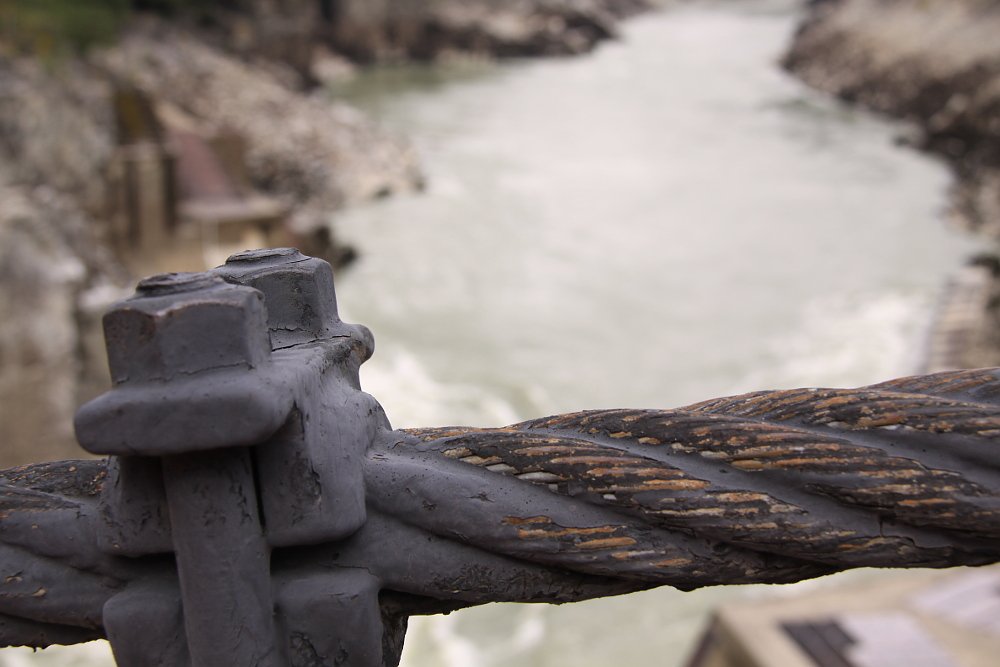
We use full locked cable for permanent handrail and walkway cables on bridges because the smooth locked surface is comfortable to handle, resists rain and dirt ingress, and can be clamped or socketed cleanly, and we use standard 6X36WS or 35WXK7 construction for temporary catwalk ropes where the rope is handled repeatedly and cost matters more than appearance.
Handrail cable has to satisfy a real load case. Someone will lean on it. In many jurisdictions the handrail is designed as a structural member with a horizontal load applied, not as a decorative element. We size the cable for that load and confirm the anchorage, because a strong cable on a weak post is still a failed handrail.
Catwalk ropes are a different discipline. They are reused, dragged along the cable line, and bent over sheaves at sharp angles. They need to survive abrasion and bending more than they need to look good. We specify the diameter to fit the catway sheave, and we advise against using a full locked cable here, because the locked surface can be damaged in handling and does not tolerate the repeated sharp bending of a catway.
What Corrosion Protection Does a Bridge Cable Need?
Every bridge cable is exposed to water. Some are exposed to salt. This is where the specification must be decided early, because protection cannot be added after installation.
We protect bridge cables with galvanized or Galfan-coated wires, an internal blocking compound applied during stranding, and a sheathing system where the design calls for it. For coastal and marine exposure we recommend Galfan coating, and for very aggressive environments we can supply AISI 316 stainless strand.
| Protection method | What it does | Where we recommend it |
|---|---|---|
| Hot-dip galvanized wire | Zinc layer protects each wire | Inland bridges, moderate exposure |
| Galfan coating, 95% Zn / 5% Al | Two to three times the service life of plain galvanizing | Suspension bridge main cables, hangers, coastal projects |
| Internal blocking compound | Fills spaces and limits moisture movement inside the strand | All structural strand applications |
| External sheathing | Adds a barrier between cable and environment | Severe exposure, cable nets, architectural applications |
| AISI 316 stainless | Highest corrosion resistance | Marine, industrial, and highly exposed structures |
| Protected socket transition | Limits water entry at the termination | Any cable with a termination in an exposed position |
One detail that gets missed: the termination. A cable can have perfect corrosion protection and still fail at the socket, because water sits at the interface between the sheath and the strand. We seal and protect that transition as part of the assembly, not as an afterthought.
What Standards Apply to Bridge Wire Rope?
Bridge cable supply is a documentation-heavy business. The cable has to match the designer’s calculation and the inspecting authority’s requirements.
We work to EN 12385-10 for spiral strand and full locked cable, EN 1993-1-11 for structural design values, EN 13411-4 for socketed assemblies, and ASTM A586 for American standard zinc-coated structural strand. We issue a certificate pack with every shipment and we support third-party witnessing on major projects.
What a bridge client normally receives in the document pack:
- Wire rod chemistry and mechanical property certificates
- Wire tensile, torsion, and bending test results
- Strand test certificate with measured breaking load and mass
- Prestretching record
- Socket proof-load certificate for every assembly
- Coating weight and adhesion test report
- Packing record and length marking
- Third-party test report where the contract requires it
On the Haramain high-speed railway project in Saudi Arabia, we supplied AISI 316 stainless spiral strand for the Madinah and KAEC station roofs, 1,300 assemblies in Ø28 and Ø20, supplied to BS EN 1993-1-11 and EN 12385-10, with third-party test reports for every lot alongside the works certificates. That is the level of documentation we treat as standard for structural work.
How Do You Handle Bridge Cable Installation and Socketing?
The best cable in the world fails if it is installed badly. This is where most bridge problems actually originate.
We issue termination and interface drawings for approval before production, we pre-stretch the cable to remove constructional elongation, and we proof-load every assembly before it leaves the plant. On site we recommend controlled tensioning, marked torque or wedge settings, and protection of the cable during erection.
Three rules cover most of it.
Drawings Before Cable
Every interface gets drawn and signed off before we manufacture anything. Anchor positions, socket lengths, and the direction of the lay relative to the anchorage all matter. Fixing these after the cable arrives costs more and delays the project.
Prestretch Before Delivery
A new structural cable has constructional stretch. If it is installed without prestretching, the geometry shifts as the load comes on. We prestretch in the plant so the engineer’s calculation holds from the first day of service.
Proof Load Every Assembly
We proof-load 100% of assemblies to the EN 13411-4 regime and issue a certificate for each one. A cable is only as good as its termination, so the termination belongs in our scope.
How Does Bridge Cable Cost Compare with Conventional Wire Rope?
This is a fair question from contractors, and the honest answer is that structural bridge cable is not priced like ordinary rope. It should not be.
We price bridge cable as a complete assembly, not as a length of steel per kilogram, because the coating, the prestretching, the terminations, the proof load, and the certification are a large part of what the buyer is paying for. Comparing a structural cable against a standard rope on unit price alone hides the real cost of the project.
Here is what actually drives the cost of a bridge cable package.
| Cost driver | Effect on price |
|---|---|
| Diameter and metallic cross-section | The largest single driver, driven by breaking load and stiffness |
| Strength grade, 1670 or 1770 MPa | Higher grade allows a smaller diameter for the same load |
| Coating system | Galfan or stainless adds cost but can reduce replacement cycles |
| Prestretching | Adds process cost, removes a long-term movement problem |
| Termination type | Spelter, resin, swaged, fork and eye differ in cost and in site handling |
| Proof load and third-party witnessing | Required by most public contracts |
| Length accuracy and packing | Critical for long lengths and for sea freight |
The right comparison is not price per kilogram. It is the total installed cost over the design life, including the cost of replacing a cable that corrodes early or a project that stops while a certificate is chased.
What Is the Track Record of Bridge Cable From Aulone?
Structural cable is a business where references matter more than claims.
We have delivered more than 55,700 metres of structural spiral strand since 2018 across 40 deliveries, at diameters from 28 mm to 140 mm and grades from 1470 to 1670 MPa, for stadium roofs, railway stations, and bridges on three continents.
A few of the projects that our clients were willing to reference publicly:
| Project | Diameter | Grade | Length | Year |
|---|---|---|---|---|
| Beijing National Speed Skating Oval | 74 mm | 1570 MPa | 9,430 m | 2018.07 |
| Beijing National Speed Skating Oval | 64 mm | 1570 MPa | 9,332 m | 2018.07 |
| Sanya Sports Center | 80 mm | 1570 MPa | 4,608 m | 2020.01 |
| Dalian Suoyuwan Football Stadium | 120 mm | 1570 MPa | 3,224 m | 2021.09 |
| Taishan Fitness Center Stadium | 95 mm | 1570 MPa | 3,177 m | 2020.09 |
| Shanghai Pudong Football Stadium | 110 mm | 1570 MPa | 960 m | 2020.04 |
| Hangzhou Xiaohong Construction | 140 mm | 1470 MPa | 864 m | 2022.01 |
| Shaoxing International Convention Center | 140 mm | 1470 MPa | 205 m | 2021.06 |
On the bridge side, we supplied the main cable and hangers for the suspension bridge at Morona Santiago in Ecuador, with an 86 mm main cable and 36 mm hangers in Galfan.
How Do You Order Bridge Wire Rope?
Structural cable orders start with drawings, not with a table of diameters.
We ask for the drawings, the load cases, the diameters, the design standard, the environment, and the delivery programme. We then return a cable schedule with termination details, an interface drawing, and a delivery plan for approval.
The information we need for a bridge cable enquiry:
| Required item | Example |
|---|---|
| Cable function | Main cable, hanger, stay, handrail, catwalk |
| Diameter and length | 86 mm, 1,200 m per coil |
| Design tension | Factored tension at the saddle, in kN |
| Design standard | EN 1993-1-11, AASHTO LRFD, or local code |
| Environment | Inland, coastal, marine, industrial |
| Termination | Spelter socket, resin socket, swaged, fork and eye |
| Testing and certification | EN 12385-10, EN 13411-4 proof load, third-party witness |
| Delivery programme | Site erection sequence and required on-site dates |
We produce spiral strand from 20 to 160 mm and full locked cables from 40 to 140 mm, with Galfan, hot-dip galvanized, bright, and AISI 316 options. We run four production lines, and we can deliver to the erection sequence rather than in one batch, because a bridge site rarely wants all its cable at once.
What Should You Ask a Bridge Cable Supplier?
Before you ask for a price, ask what is included.
I recommend asking: is the quote for the cable only or the complete assembly, who does the socketing, what testing is included, what is the prestretching procedure, what standards does the certificate cover, and can you provide references on comparable projects. If the answer to the first question is “cable only”, the comparison you are making is not a like-for-like one.
Send us the drawings and the load cases. We will return a technical proposal with a cable schedule, termination details, and a delivery programme.
Conclusion
We choose bridge wire rope by matching the construction, diameter, coating, and termination to each specific duty, then supply it as a tested, certified assembly with the drawings agreed before production starts.