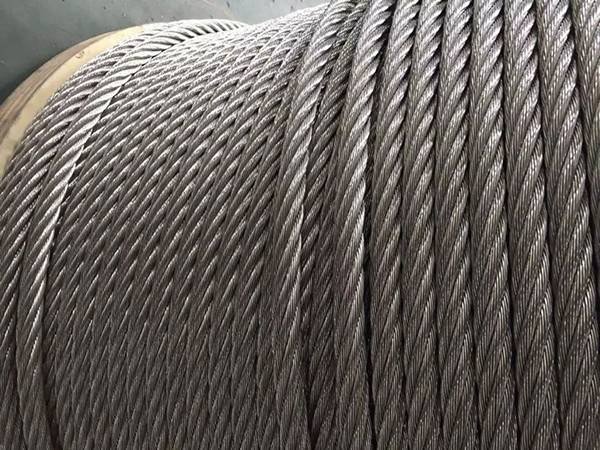
A stadium roof cable, a railway station roof, a suspension bridge main cable. They look different from the ground and they work on completely different principles. What connects them is the same engineering decision, made again and again, to build a long, slender tension member out of steel wire and nothing else.
Spiral strand is a concentric, all-metal cable built from round high-strength wires, laid in alternating layers so the torque cancels out. We supply it from Ø20 to Ø160 mm in constructions from 1×7 to 1×547, in 1670 and 1770 MPa grades with Galfan protection, to EN 12385-10 and ASTM A586.
Since 2018 we have delivered more than 55,700 metres of structural spiral strand across 40 deliveries, for stadium roofs, railway stations, and bridges on three continents. This article explains how the product works, what the numbers mean, and how to specify it properly.
What Is a Spiral Strand Cable?
The name describes the construction exactly.
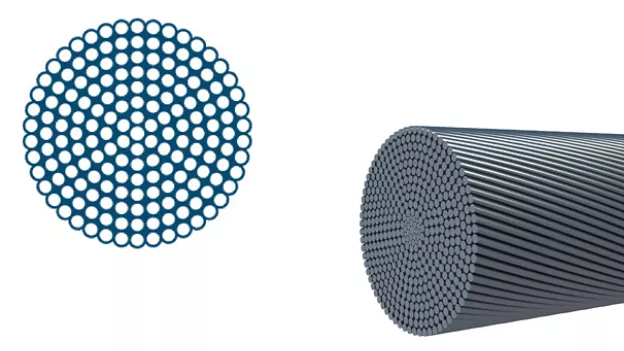
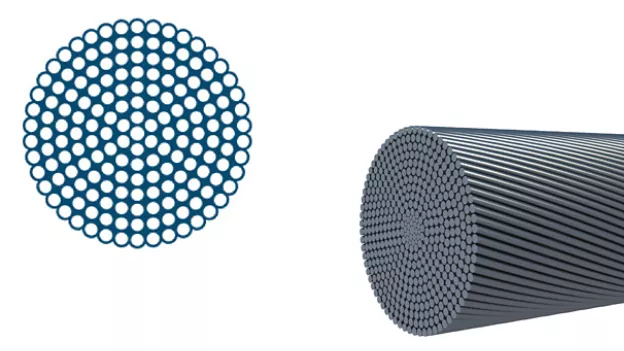
We build a spiral strand by spinning round steel wires helically in several concentric layers, each layer laid in the opposite direction to the one beneath it. The result is a dense, fully metallic cable with a high elastic modulus and predictable behaviour under load.
Three properties follow directly from this construction.
First, alternating lay cancels torque. Each layer tries to rotate the cable in one direction as it is tensioned. The layer above counteracts it. This is why a spiral strand stays straight when it is unloaded and does not spin in service.
Second, the section is nearly solid steel. There is almost no void space, so a spiral strand carries a very high breaking load for its diameter.
Third, blocking compound and lubricant are applied during stranding. This limits internal movement between wires and blocks the migration of moisture into the section.
That is a different philosophy from a conventional wire rope. A rope is built to be flexible and to bend around a sheave. A spiral strand is built to be stiff and to act as a structural element. You will not spool a spiral strand onto a drum and bend it around a small sheave.
How Is a Spiral Strand Cable Built Up?
The build-up determines everything else about the cable.
We supply seven standard constructions, from 1×7 up to 1×547 wires. Every added layer raises the diameter and the breaking load while the section stays torque-balanced, and intermediate builds, compacted sections, and stainless variants are produced to project specification.
| Construction | Wires | Typical service |
|---|---|---|
| 1×7 | 7 wires | Smallest sections, guys, light stays |
| 1×19 | 19 wires | Compact sections, railings, small anchors |
| 1×37 | 37 wires | Structural stays, Ø20 station cables |
| 1×61 | 61 wires | Medium structural cables |
| 1×91 | 91 wires | Large stays and roof cables |
| 1×127 | 127 wires | Long-span roofs, suspension cables |
| 1×547 | 547 wires | Maximum build-up, Ø140 to Ø160 ring and main cables |
A real reference for this: on the Haramain high-speed railway stations in Saudi Arabia, we supplied Ø20 as 1×37 and Ø28 as 1×19 in AISI 316 stainless steel, to BS EN 1993-1-11.
What Does Alternating Lay Actually Achieve?
Each layer counter-rotates against the layer beneath it. Layer by layer, the torque cancels. This is what keeps the strand free of rotation under load, and it is why a spiral strand can be installed in a fixed position and stay in that position for decades.
It also affects installation. A torque-balanced strand does not twist during erection, so the geometry the engineer designed is the geometry that gets built.
What Sizes and Grades Are Available?
Spiral strand is a made-to-order product. We publish the range, not a fixed catalogue.
We supply spiral strand from Ø20 to Ø160 mm, in 1670 and 1770 MPa grades, with 1470 MPa for AISI 316 stainless, in Galfan, hot-dip galvanized, bright, or AISI 316 finish, with alternating cross-lay, prestretched on request.
| Parameter | Range and options |
|---|---|
| Construction | 1×7, 1×19, 1×37, 1×61, 1×91, 1×127 up to 1×547 |
| Diameter | 20 to 160 mm |
| Tensile grade | 1670 / 1770 MPa, 1470 MPa for AISI 316 stainless |
| Coating | Galfan 95% Zn / 5% Al, hot-dip galvanized, bright, AISI 316 |
| Lay and torque | Alternating cross-lay, torque-balanced, rotation-free under load |
| Elastic modulus | 150 GPa design value, prestretched, to EN 1993-1-11 |
| Prestretching | Constructional stretch removed before dispatch |
| Standards | EN 12385-10, ASTM A586, BS EN 1993-1-11 |
| Terminations | Spelter or resin socket, swaged fitting, fork and eye sockets, to EN 13411-4 |
| Lubrication | Blocking compound and lubricant applied during stranding |
| Packing | Wooden reel or coil, seaworthy export packing, length-marked |
Why Does the Elastic Modulus Matter So Much?
For a long-span structure, the modulus decides how the structure behaves. A stiffer cable stretches less under the same load, which means less deflection, smaller geometric change under traffic, and more predictable tension distribution between parallel cables.
We work to the design values in EN 1993-1-11: 150 GPa for spiral strand and 170 GPa for locked coil. These are the numbers an engineer puts into the calculation, so we build to them and prestretch before dispatch so the cable behaves that way from day one.
What Are the Six Engineering Advantages of Spiral Strand?
These are the reasons a designer chooses a structural strand over a wire rope.
We rely on six properties: high axial stiffness, high breaking load, torque balance, clamping capability, fatigue resistance, and Galfan corrosion protection. Each one solves a specific problem that would otherwise appear in the structure.
| Advantage | What it solves |
|---|---|
| High axial stiffness | A dense all-steel section deflects little under load, giving predictable geometry for long-span roofs and facades |
| High breaking load | 1670 and 1770 MPa wires fill the section, so a smaller diameter carries the same force |
| Torque balanced | Cross laying in opposite directions cancels rotation, giving stability during erection and in service |
| Clamping capability | Round outer wires grip evenly under clamps, saddles, and sockets, with no stress peaks |
| Fatigue resistance | Long lay lengths and line contact between wires resist cyclic loading at anchors and saddles |
| Galfan corrosion | Zinc-aluminium coating gives two to three times the service life of plain galvanizing |
The clamping point deserves attention. A spiral strand is often held by a saddle or a clamp rather than a socket alone, and the round outer wires bear evenly on the saddle. The load spreads across several wires instead of concentrating on one. For a structure that will be loaded for thirty years, that evenness is the difference between a detail that lasts and a detail that fretts and fails.
How Does Galfan Protect a Spiral Strand?
Long-span structural cables live outdoors. Some of them live near the sea.
We use Galfan coating, 95% zinc and 5% aluminium, on our spiral strand. It gives two to three times the service life of plain galvanizing, and combined with the blocking compound applied during stranding it forms a layered defence against corrosion.
The protection is not only on the outside. Blocking compound fills the internal spaces and limits the movement of moisture between wires. This matters because in a large structural section, an internal void that collects water is where corrosion starts quietly.
Where the exposure is more aggressive, we supply AISI 316 stainless at 1470 MPa. On the Haramain stations we supplied 316 stainless spiral strand for exactly this reason, and the project was delivered to BS EN 1993-1-11 with third-party test reports for every Ø28 and Ø20 lot.
How Is a Spiral Strand Cable Manufactured?
Structural cable has no tolerance for a weak link, so we keep the whole process in our own hands.
We draw the wire, patent it, coat it, and strand it under one roof, with thirteen controlled steps and three inspection gates, so the lead time and the quality stay inside our control. Wire rod comes in with a certificate and heat number recorded, and every step is traceable to the delivery.
| Step | What happens |
|---|---|
| 1 to 7 | Wire rod certificate and chemistry check, surface and diameter check, first drawing, patenting heat treatment, second drawing to final diameter, then Galfan coating |
| 8 to 9 | Prestretching to remove constructional stretch, then stranding layer by layer with alternating lay |
| 10 to 13 | Finished mechanical checks, the completed spiral strand, socketing, then reel or coil packing with length marking |
Three inspection gates control the order. The first is incoming material: rod certificate, chemistry, surface. The second is in process: lay length, diameter, coating mass. The third is final: proof load, packing, certificate pack.
What Plant Do We Run?
We draw wire on LZ4/1200, LZ8/900, LZ8/700, and LW1/450 lines plus an LT17/360 line, with multiple closing lines running in parallel in the stranding hall. Our capability covers Ø20 to Ø160 mm, single lengths to project requirement, a 4000 t press, and a 2000 t by 800 m full-size test bed.
How Do You Test a Spiral Strand?
You cannot verify a 140 mm cable on a laboratory bench.
We test in our CNAS-accredited laboratory with a 4000 t compression press and a 2000 t by 800 m full-size test bed, we proof-load 100 percent of assemblies, and we issue a certificate pack with every shipment. On major projects, third-party institutes witness or repeat the full-size breaking and proof-load tests.
| What we test | Frequency |
|---|---|
| Metallographic analysis | Every heat |
| Chemical composition | Every heat |
| Breaking, torsion, and bending | Every wire lot |
| Lay length and diameter | In process |
| NDT and proof load | Per assembly |
Every shipment carries a certificate pack with five document classes: rod chemistry, wire tests, strand test, assembly proof load, and the packing record, all referenced to the delivery. Three inspection gates per order, five document classes per pack. That is our standard, not an upgrade.
Where Do We Use Spiral Strand?
Spiral strand is used wherever a long, slender member has to carry tension and stay in position for decades.
We use spiral strand for stay cables, hangers, catwalk ropes, catenaries, ring cables, radial cables, and edge cables, in stadium roof cable systems, long-span roofs, and bridge structures.
Sports and Roof Structures
Cable-net and cable-truss stadium roofs are the classic application. The roof load is transferred to masts, compression rings, or foundations through a network of cables, and every cable in that network is a spiral strand.
On the Panjin stadiums in Liaoning we supplied suspension, edge, valley, and stay cables from Ø20 to Ø120 mm, together with a locked coil tension ring, with China Construction Eighth Engineering Division as the main contractor. On the Xuzhou Olympic Sports Center we supplied six ring cables of approximately 587 m each at Ø121 mm. At the Qingdao North Railway Station we supplied a Ø140 mm spiral strand, the largest spiral strand in a Chinese space structure, in the Ø30 to Ø140 mm range. The Yueqing Sports Centre used Ø32 to Ø135 mm in Galfan, and the Hong Kong Stadium and Al Menaa in Iraq used Ø77 mm stadium roof cable systems.
Bridges and Transport
On the suspension bridge at Morona Santiago in Ecuador, we supplied an 86 mm main cable and 36 mm hangers in Galfan. On the Haramain high-speed railway in Saudi Arabia, we supplied 1,300 assemblies of AISI 316 stainless spiral strand, Ø28 and Ø20, at 1470 MPa, to BS EN 1993-1-11 and EN 12385-10.
What Is the Track Record for Spiral Strand?
Structural cable is a long-cycle business. A buyer today may not see the result until next decade, so references matter more than claims.
Between 2018 and 2022 we delivered 40 projects totalling 55,700 metres, at diameters from 28 to 140 mm and grades from 1470 to 1670 MPa. The full delivery list is available on request.
| Project | Ø mm | MPa | Length m | Year |
|---|---|---|---|---|
| Beijing National Speed Skating Oval | 74 | 1570 | 9,430 | 2018.07 |
| Beijing National Speed Skating Oval | 64 | 1570 | 9,332 | 2018.07 |
| Sanya Sports Center | 80 | 1570 | 4,608 | 2020.01 |
| Dalian Suoyuwan Football Stadium | 120 | 1570 | 3,224 | 2021.09 |
| Taishan Fitness Center Stadium | 95 | 1570 | 3,177 | 2020.09 |
| Shanghai Pudong Football Stadium | 110 | 1570 | 960 | 2020.04 |
| Hangzhou Xiaohong Construction | 140 | 1470 | 864 | 2022.01 |
| Shaoxing International Convention Center | 140 | 1470 | 205 | 2021.06 |
| DJI Sky City Tower | 120 | 1570 | 150 | 2021.06 |
How Do You Specify and Order Spiral Strand?
Structural cable orders start with drawings, and the process has seven steps.
We issue termination and interface drawings for approval before anything is made, we prestretch and proof-load every assembly, and we deliver on the programme the site needs rather than in one batch, because a bridge or stadium site rarely wants all its cable at once.
| Step | What happens |
|---|---|
| Enquiry | Drawings, diameters, load cases |
| Proposal | Cable schedule, terminations, price |
| Approval | Interface drawings signed off |
| Production | In-process QC, traceable heats |
| Testing | Full-size proof load, certificates |
| Dispatch | Export packing, shipping documents |
| Site | Installation support on request |
The information we need for a quotation:
| Required item | Example |
|---|---|
| Cable function | Stay, hanger, catwalk, ring, radial, edge cable |
| Construction and diameter | 1×127, Ø86 mm |
| Design tension | Factored design load in kN |
| Design standard | EN 1993-1-11, AASHTO, or local code |
| Environment | Inland, coastal, marine, industrial |
| Material and finish | Galfan, hot-dip galvanized, bright, or AISI 316 |
| Prestretching | Required or not |
| Termination | Spelter, resin, swaged, fork and eye |
| Length per coil and quantity | 1,500 m per coil, 4 coils |
| Testing and certification | EN 12385-10, EN 13411-4 proof load, third-party witness |
What Should You Ask a Spiral Strand Supplier?
Ask the questions that separate a structural cable supplier from a rope supplier.
I recommend asking: do you draw and strand in-house, what is the maximum diameter you can full-size test, can you prestretch before dispatch, do you proof-load every assembly, which standard does your certificate cover, and can you show a reference on a comparable project.
The full-size test bed question is the one that sorts the field quickly. A supplier who cannot break a 140 mm cable at full size cannot prove the numbers on the certificate for a 140 mm cable.
Send us the drawings and the load cases. We will return a technical proposal with a cable schedule, termination details, and a delivery programme.
Conclusion
We choose spiral strand by matching the construction, diameter, grade, coating, and termination to the design load, then prove it with full-size testing, prestretching, and a certificate pack issued with the delivery.