A mine hoist rope gets replaced every few months and nobody can say why. The drum looks fine, the sheaves look fine, but the rope keeps laying broken wires on the bed. Then the engineer checks the drawing and finds the same mistake: a round strand rope was specified for a job that wanted a shaped strand.
We recommend shaped strand wire rope when the duty is high-cycle and the rope is bending over sheaves or running on a drum under load, because the shaped strand profile gives a larger wire-to-wire contact area, a higher breaking force at the same diameter, and far better fatigue and wear resistance than a round strand rope. Our shaped strand constructions include 4V×39 and 4V×48S in a four-strand V layout, and 6V×21, 6V×24, 6V×30, 6V×34 and 6V×37 in a six-strand V layout.
Here is what the shape actually changes, what it costs, and how we tell you which construction to use.

What Is Shaped Strand Wire Rope?
A shaped strand rope starts like an ordinary rope. The wires are still high-carbon steel, still laid into strands around a core. The difference happens in the final forming step.
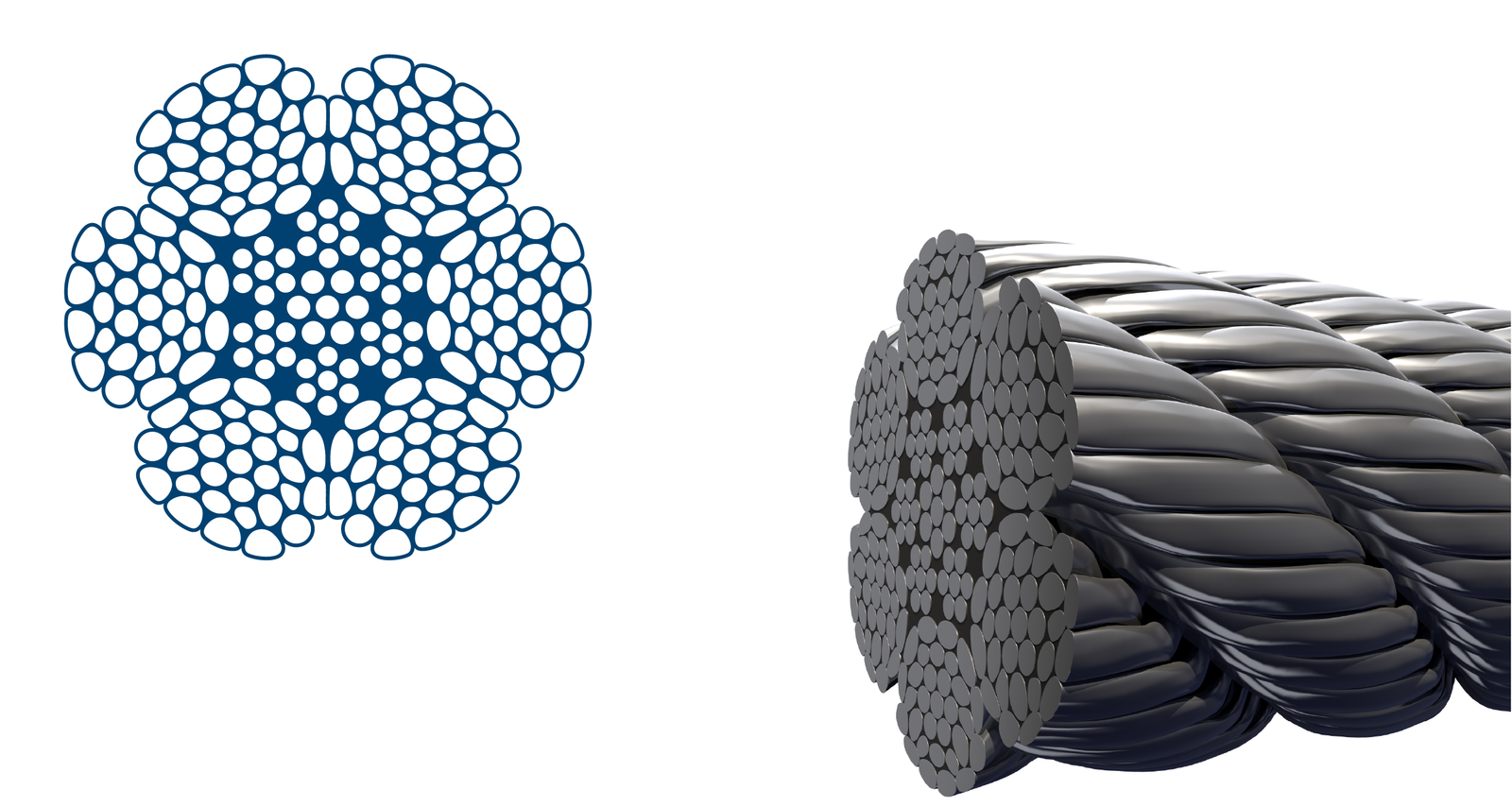
Shaped strand wire rope is made by mechanically pressing the strands so the wires take a flattened, shaped profile instead of staying perfectly circular. Because the shaped wires nest together instead of sitting on each other as loose circles, the contact area between wires increases, the internal voids close up, and more steel ends up inside the same nominal diameter. The rope gains breaking strength, loses internal friction, and distributes stress more evenly across the strand.
Our shaped strand product page puts it this way: shaped strands provide more contact points and reduce gaps between wires, which increases the rope’s overall breaking strength and load-bearing capability. The result is a rope that spools more neatly on drums and sheaves without birdcaging or uneven layering, and that lasts longer because the internal wire-to-wire friction is lower.
How Does a Shaped Strand Rope Differ From a Round Strand Rope?
Both are made from the same wires and the same steel grades. Only the strand geometry differs, and that one difference changes the whole behaviour of the rope.
A shaped strand rope carries a larger wire-to-wire contact area, a higher breaking force at the same diameter, better anti-abrasion performance, better fatigue resistance and better structural stability than a round strand rope. A round strand rope keeps one advantage: it is more flexible and it bends around a smaller sheave diameter.
| Property | Round strand rope | Shaped strand rope |
|---|---|---|
| Wire cross section | Round wires | Flattened, shaped wires |
| Wire-to-wire contact area | Point contact | Larger surface contact area |
| Breaking force at same diameter | Standard | Higher |
| Metal filling coefficient | Standard | Bigger filling coefficient |
| Anti-abrasion performance | Standard | Excellent |
| Fatigue resistance | Standard | Excellent |
| Structural stability | Standard | Excellent |
| Flexibility | Higher | Lower |
| Spooling on drums | Standard | Neater, no birdcaging |
The last line is the trade. Shaped strands hold their profile under pressure, so the rope layers evenly on a drum. That matters on a hoist drum where a lumpy layer changes the groove geometry and starts a rope to sit on the edge of the previous layer.
Which Shaped Strand Constructions Do We Supply?
We build shaped strand rope in four-strand and six-strand V layouts, and the letter V in the designation is the standard marker for the strand shape.
EN 12385-2 classifies a triangular strand with the symbol V, and a round strand with no symbol. Our shaped strand line covers 4V×39 and 4V×48S in the four-strand V layout, and 6V×21, 6V×24, 6V×30, 6V×34 and 6V×37 in the six-strand V layout. We build them bright or galvanized, in fiber core and steel core, and in the 1570, 1670, 1770 and 1870 MPa grades depending on the construction.
The cross-section drawings below are our own, and they show how the V profile changes the packing in each layout.
What Do Our 4V×39 Figures Show?
Here is the published 4V×39 parameter table. The advantage list on our own sheet is higher breaking force, a bigger wire rope filling coefficient, excellent anti-abrasion performance, and extrusion resistance and stability.
| Diameter | Approx. weight | MBL at 1770 MPa | MBL at 1960 MPa | MBL at 2160 MPa |
|---|---|---|---|---|
| 8 mm | 26 kg/100m | 41 kN | 45 kN | 50 kN |
| 12 mm | 59 kg/100m | 92 kN | 102 kN | 112 kN |
| 16 mm | 105 kg/100m | 163 kN | 181 kN | 199 kN |
| 20 mm | 164 kg/100m | 255 kN | 282 kN | 311 kN |
| 24 mm | 236 kg/100m | 367 kN | 406 kN | 448 kN |
| 30 mm | 369 kg/100m | 573 kN | 635 kN | 700 kN |
| 36 mm | 531 kg/100m | 826 kN | 914 kN | 1008 kN |
| 40 mm | 656 kg/100m | 1020 kN | 1129 kN | 1244 kN |
| 48 mm | 945 kg/100m | 1468 kN | 1626 kN | 1792 kN |
Note the diameter range. 4V×39 starts at 8 mm and runs to 48 mm in our published sheet, with the metal filling coefficient higher than a round strand rope of the same size. That is the point of the construction: more steel in the same space.
What About Filled Strand Ropes for Mine Hoisting?
Mine hoist rope is where the shaped strand idea is often confused with the filled strand idea, so it is worth separating the two.
A filled strand rope fills the gaps between the strands with extra fine wires. That is a different mechanism from the shaped strand, and our own 6X25TS-FC sheet is a filled construction: our advantage list reads larger surface contact area, higher breaking force compared to 6-strand wire ropes, excellent structural stability, outstanding fatigue resistance and wear resistance, and an advanced galvanizing process for corrosion resistance. It is supplied bright or galvanized, in lang lay, for vertical shaft hoisting, inclined shaft hoisting and other mining lifting applications, from 22 mm to 58 mm in the 1570, 1670, 1770 and 1870 MPa grades.
| Diameter | Approx. mass | MBL at 1570 MPa | MBL at 1670 MPa | MBL at 1770 MPa | MBL at 1870 MPa |
|---|---|---|---|---|---|
| 22 mm | 196 kg/100m | 274 kN | 291 kN | 308 kN | 326 kN |
| 30 mm | 364 kg/100m | 509 kN | 541 kN | 573 kN | 606 kN |
| 36 mm | 525 kg/100m | 732 kN | 779 kN | 826 kN | 872 kN |
| 40 mm | 648 kg/100m | 904 kN | 962 kN | 1020 kN | 1080 kN |
| 48 mm | 933 kg/100m | 1300 kN | 1390 kN | 1470 kN | 1550 kN |
| 58 mm | 1360 kg/100m | 1900 kN | 2020 kN | 2140 kN | 2260 kN |
Lang lay is worth noting for a hoist rope. Lang lay ropes have better resistance to untwisting and better fatigue life under rotation than ordinary lay, which matters when the rope spools on and off the drum in one direction. For a mine hoist, where the drum works in a fixed direction for years, that is the point.
So when we are asked for a mine hoist rope, we ask which mechanism the machine actually needs. If the requirement is a shaped strand profile with higher contact area and better fatigue behaviour, that is the V layout. If the requirement is a denser cross section with more metal in the same diameter and better crushing resistance, that is the filled strand. They are not the same choice, and we will tell you which one fits.
Where Does Shaped Strand Beat Other Constructions?
Shaped strand is not the answer everywhere, so it is worth being specific.
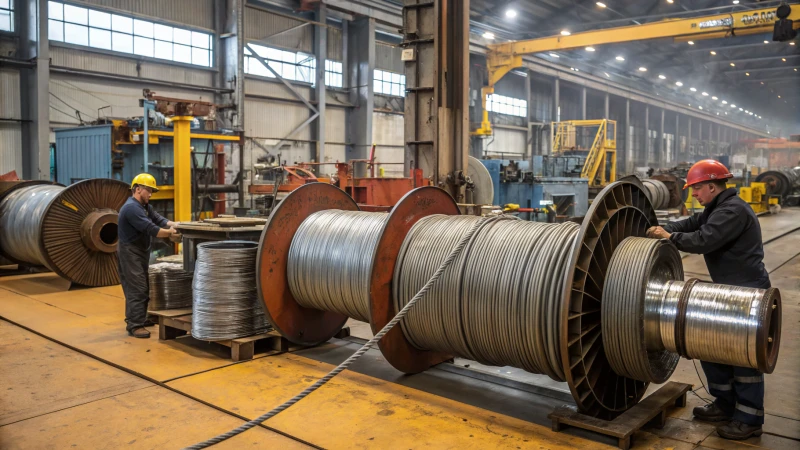
We use shaped strand wire rope for mine hoist ropes, draglines and dragline excavators, for marine mooring lines, winches and cranes, for tower cranes and elevators, and for industrial conveyors and heavy machinery where the rope has to move precisely. We choose it over a round strand rope when the bending cycle is high, the drum pressure is high, and the rope has to survive long exposure.
Our shaped strand product page lists the same application set: mining and heavy lifting, marine and offshore, construction including tower cranes and elevators, and industrial machinery.
Where we do not choose it, the reason is flexibility. A shaped strand is stiffer. It wants a larger minimum sheave diameter than the equivalent round strand rope. If your machine has small sheaves and a high cycle count, a more flexible construction may still be the better answer, and we will say so.
Which Core and Which Surface Condition?
The two choices that are left after you pick the construction are the core and the surface.
We supply shaped strand rope with a fiber core where flexibility and shock absorption matter most, and with a steel core where crushing resistance and load capacity matter most. On the surface, we supply bright, hot-dip galvanized, plastic impregnated or plastic coated, and our galvanizing process is what gives the corrosion resistance on the 6X25TS line.
| Selection point | Fiber core | Steel core |
|---|---|---|
| Flexibility | Higher | Lower |
| Shock absorption | Better | Standard |
| Resistance to crushing | Lower | Higher |
| Breaking load at equal diameter | Lower | Higher |
| Typical shaped strand use | Mine hoisting, filled strand construction | Marine and heavy lifting |
Our 6X25TS-FC sheet also notes an advanced galvanizing process that ensures superior corrosion resistance. On a shaft hoist, that galvanizing is usually hot-dip, and it is the difference between a rope that survives the wet shaft and one that does not.
What Has Actually Been Ordered?
Real orders tell you more than a catalogue. Here is what we have quoted and supplied in this family.
We have supplied 4V×39 in a galvanized finish at 1960 MPa in right-hand ordinary lay, in 33.5 mm lengths of 1800 m supplied on three reels. We have also supplied 35WXK7 compacted rope in the same period, in 16 mm to 26 mm, at 1960 MPa and 2160 MPa, in lengths of 2000 m to 3000 m.
| Construction | Finish and grade | Dia | MBL | Quantity |
|---|---|---|---|---|
| 4V×39 | Galvanized, 1960 MPa, RHRL | 33.5 mm | 792 kN | 1800 m, 3 reels |
| 35WXK7 compacted | Ungalvanized, 1960 MPa, RHLL | 16 mm | 238 kN | 3000 m |
| 35WXK7 compacted | Galvanized, 2160 MPa, RHLL | 26 mm | 657 kN | 2000 m |
That 4V×39 line shows why the lay direction and the reel length have to be specified separately. A 1800 m length on three reels is a packing decision, and right-hand ordinary lay on a mine rope is a performance decision. Neither one should be left to the order desk by accident.
How Do You Specify a Shaped Strand Rope?
The enquiry has to carry more detail than a standard rope enquiry, because the strand shape and the lay direction both change the result.
For a shaped strand rope we ask for the construction and strand layout, the nominal diameter, the core type, the strength grade, the surface condition, the lay direction, the length per reel, the working load with its safety factor, the minimum sheave or wheel diameter, and the standard the certificate must follow. We also ask what is driving the change, because a rope replaced for fatigue and a rope replaced for corrosion are different decisions.
In practice that comes back as a line like this: 6V×37-FC, 40 mm, bright or galvanized, fiber core, 1770 MPa, EN 12385, on reels of a stated length, with the working load and the safety factor given, and the minimum wheel diameter from the hoist calculation attached. Add the drum diameter and the number of falls, and we can return a certified proposal.
What Should You Check Before a Shaped Strand Rope Goes On the Drum?
Three checks, and the first one is the one that ends rope life early.
Check the minimum sheave or wheel diameter against the new construction, confirm the rope length and reel layout against the drum capacity in layers, and confirm the certificate standard against the design calculation. A shaped strand rope is stiffer than the round strand rope you replaced, so the sheave data has to be checked against the shaped strand rope and not copied across from the old one.
The geometry check is where most problems come from. If the machine was designed for a round strand rope and the sheaves are smaller than the shaped strand construction allows, the rope will not fail at the breaking load. It will fail one wire at a time, over months, from bending fatigue, and the failure will look like bad luck.
On inspection, shaped strand rope still needs the same discipline as any steel rope: regular checks for broken wires, abrasion and corrosion, and lubrication on schedule. The shaped profile reduces internal friction, which helps, but it does not replace maintenance.
Conclusion
We choose shaped strand wire rope when the duty is hard on the rope and the machine is not going to change: mine hoists, draglines, marine winches, tower cranes and elevators. The shaped profile closes the internal voids, raises the contact area between wires and gives a rope that resists abrasion and fatigue better than a round strand rope of the same diameter. In our published tables that is 4V×39 from 8 mm to 48 mm in 1770, 1960 and 2160 MPa, and the six-strand V family across 22 mm and up. The cost is less flexibility, so the sheave diameter has to be checked before the order, not after.
Send us the construction, the diameter, the core, the grade, the surface condition, the lay direction, the standard and the length per reel, plus the working load, the safety factor and the minimum sheave or wheel diameter. We will return a technical proposal with the certified minimum breaking load and the recommended sheave dimensions.