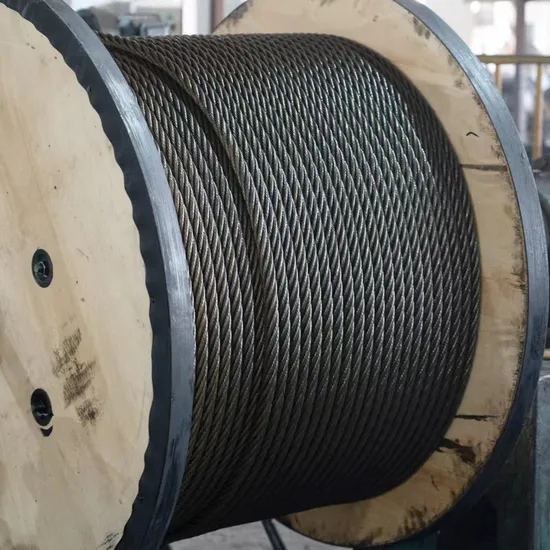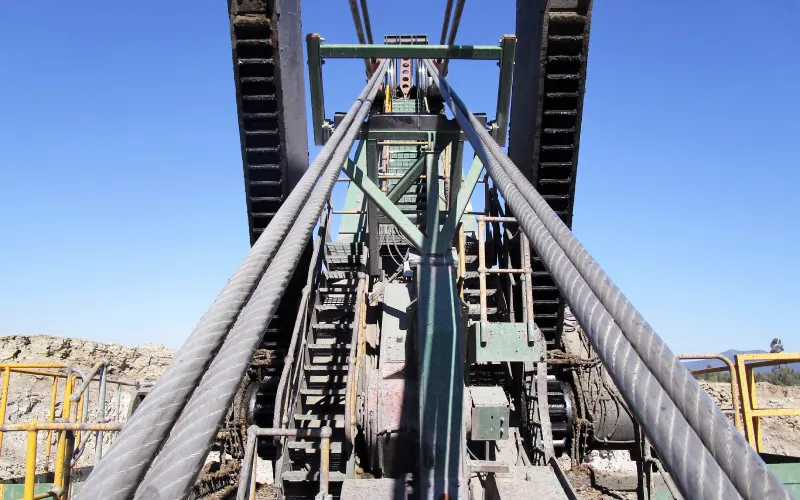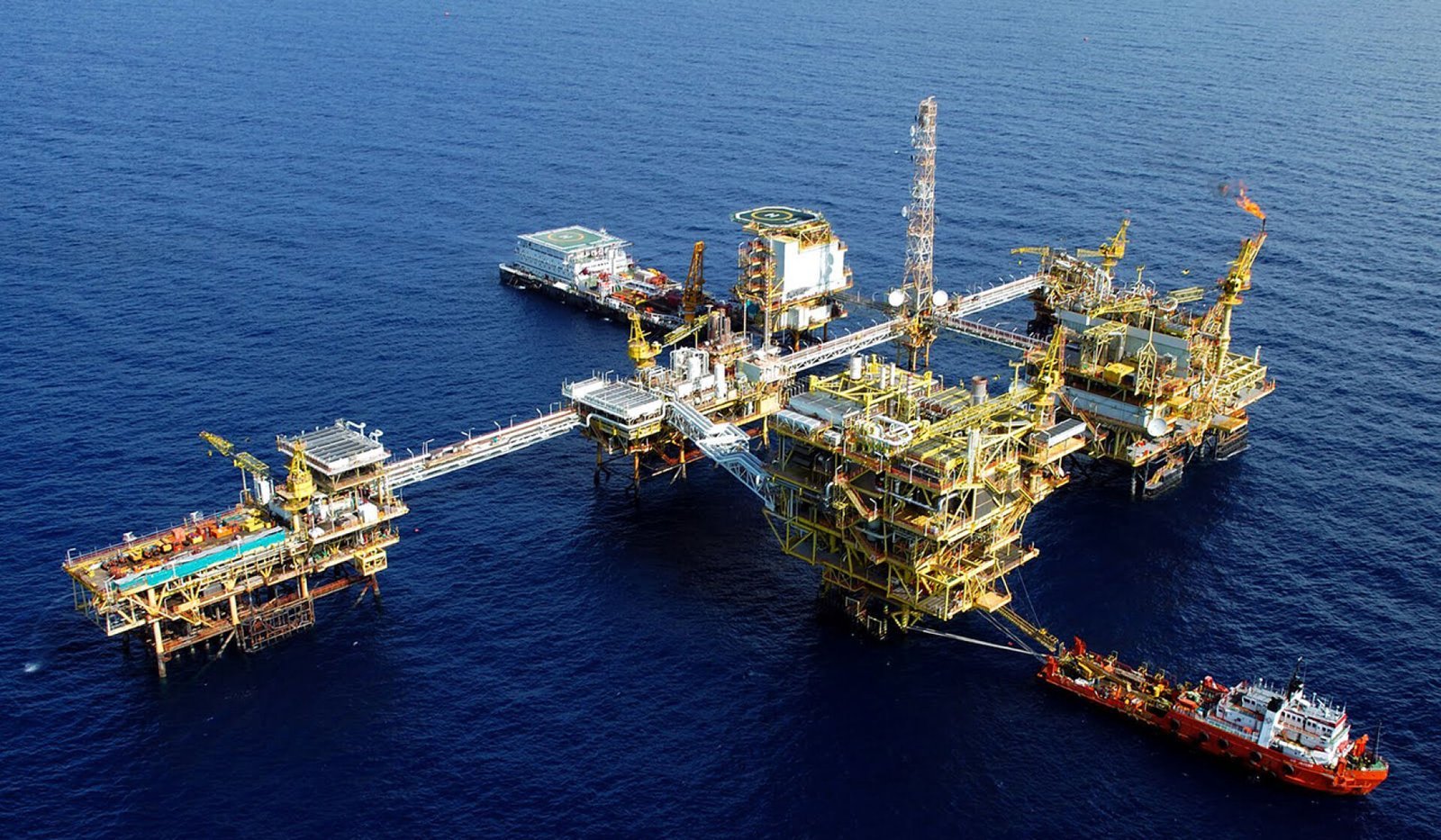
A mooring line is one of the most misunderstood products in the wire rope industry. The rope itself is simple. What makes it expensive is everything around it: the corrosion protection, the certification, the terminations, and the fact that the vessel cannot stop working while the rope is replaced.
Marine mooring wire rope must resist salt water corrosion, continuous cyclic loading, and severe abrasion at the fairlead, while meeting the class society and oil company requirements that govern the installation. We supply it from 3 to 300 mm, galvanized or stainless, with API 9A and ISO certification and certified terminations.
The consequence of getting this wrong is not a delayed shipment. It is a vessel that cannot leave port, a platform that cannot lift, and a certificate that a surveyor will not sign.
What Is Marine Mooring Wire Rope?
Mooring ropes fall into distinct duties, and each one has different demands.
We supply mooring wire rope for vessel mooring lines, heaving and running lines, towing lines, anchor handling lines, offshore crane and pedestal hoist ropes, and catenary and riser tensioning. The difference between them is not the steel. It is the duty cycle, the exposure, and the certification regime.
| Mooring duty | How it works | Main demand on the rope |
|---|---|---|
| Mooring line | Secures the vessel to the berth or buoy | Long-term load, cyclic tension, salt corrosion |
| Heaving line | Runs between vessel and shore, handled by hand or winch | Severe abrasion, repeated handling, kinking |
| Towing line | Connects two vessels during tow | Very high shock load, wear from the sea |
| Anchor handling line | Sets and retrieves anchors on an AHTS | Extreme cyclic load, constant bending over sheaves |
| Offshore crane and pedestal hoist | Lifts cargo and equipment on platform or vessel | Fatigue, salt corrosion, certified proof load |
| Catenary and riser tension | Controls the motion of a riser or floating line | Constant cyclic movement, fatigue endurance |
A vessel that operates in the North Sea and a fishing boat working off a tropical coast are both doing marine work. The rope for one is very different from the rope for the other.
Why Does Corrosion Matter So Much in Marine Rope?
Salt water is not just a surface problem. It works from the inside out.
We use hot-dip galvanized wire for marine applications because the zinc layer protects each wire individually, and we use zinc-aluminum or stainless steel where the exposure is severe. Where the rope will be stored wet or in a corrosive atmosphere for long periods, plastic impregnation keeps water out of the core.
The mechanism of failure is worth understanding. A rope made from unprotected wire in a salt environment corrodes from the outside in, but the real damage happens inside the core. Salt water gets into the spaces between wires through a damaged coating or an open end. It sits there. The rope looks acceptable from the outside while the core loses section.
Three things prevent this:
- A metallic coating on every individual wire, so a break in one wire does not expose the neighbours
- Blocking compound and lubricant applied during stranding, which fills the internal spaces and limits the movement of moisture
- Protection at the ends, because the terminations are where water actually gets in
Galvanized and stainless steel behave very differently. Zinc-aluminum coating gives two to three times the service life of plain galvanizing. Stainless steel gives the highest resistance but costs more and requires different handling at the socketing stage.
Which Rope Construction Works for Mooring?
The construction decides how the rope handles the two things marine work throws at it: constant bending and constant corrosion exposure.
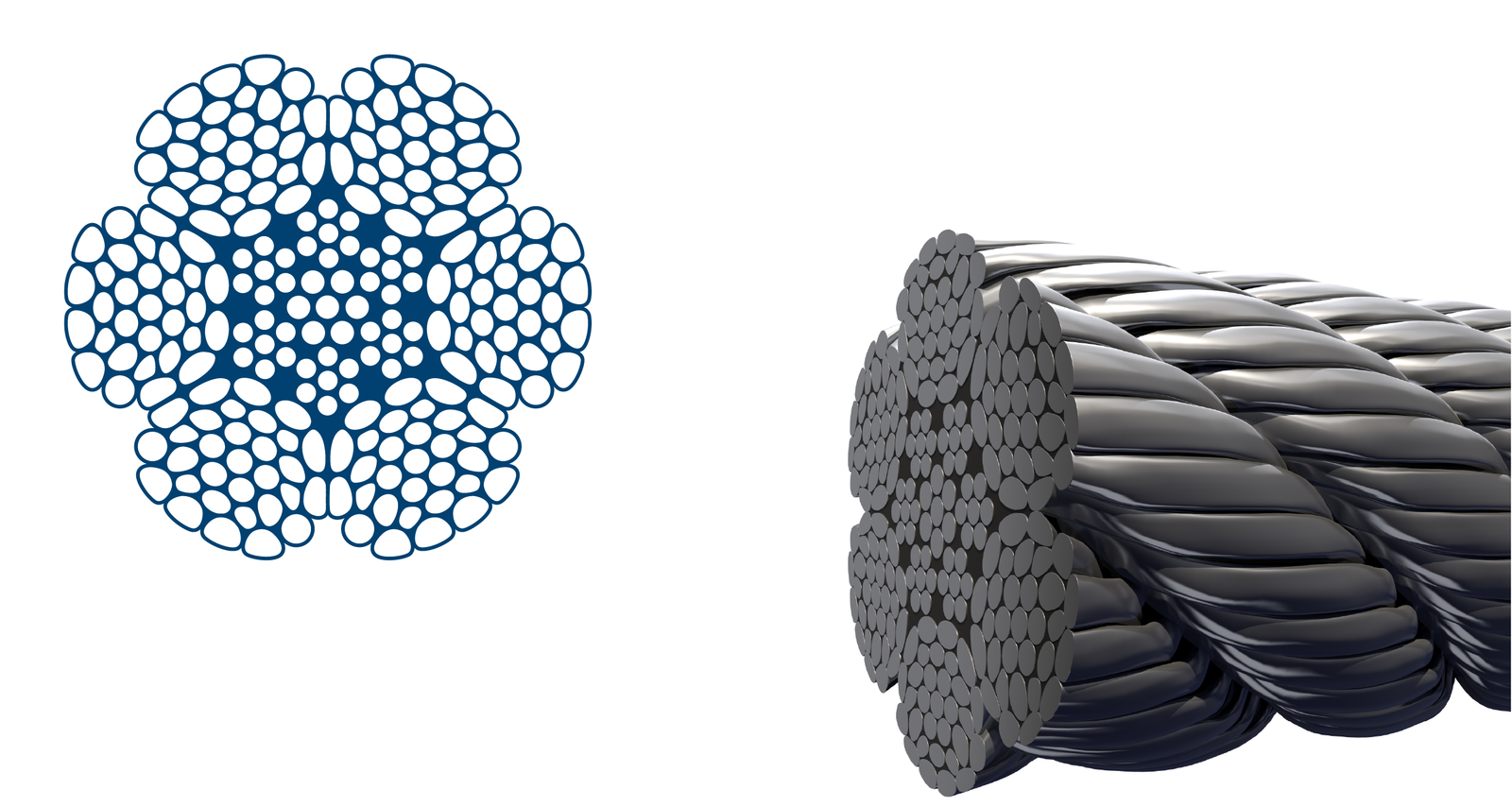
We use 6×36 construction for most mooring and heaving lines because it gives high flexibility with good abrasion resistance, and we specify an independent wire rope core for lines that carry high tension or run over tight sheaves. For large diameter mooring ropes we can supply compacted construction to increase the breaking load without increasing the diameter.
Six-by-thirty-six has more wires per strand than a six-by-nineteen, which means each wire carries less load individually. That gives better flexibility and better fatigue life, which is what a rope working over a sheave or through a fairlead needs. It also means more wires to corrode individually, which is why the coating quality matters so much.
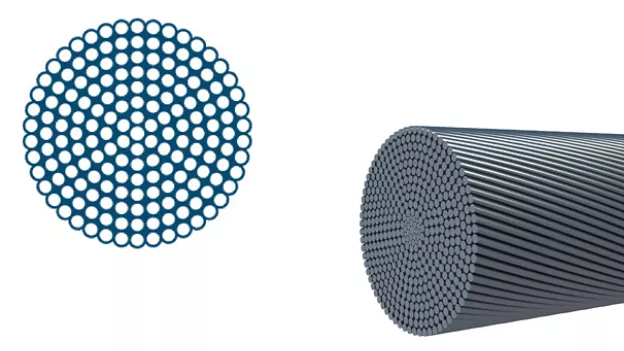
For the highest breaking loads in a limited diameter, compacted strand is the answer. Compaction increases the metallic cross-section of the rope, so the same diameter carries more load. On a deepwater mooring where diameter is constrained by the winch, this is often the only way to hit the required capacity.
What About Fiber Core?
For heaving lines that are handled a lot, the core choice is different.
We use fiber core for heaving lines where flexibility and shock absorption matter more than maximum strength, and we use an independent wire rope core for mooring lines and anchor handling lines where load capacity and crush resistance are the priority.
A fiber core absorbs shock and stores lubricant. It is more forgiving of the sharp bending that happens when a heaving line is dragged across a deck and around a cleat. An independent wire rope core gives roughly seven to ten percent more strength and holds its shape under crushing load, which matters when the line is under high tension against a capstan or a winch drum.
How Do You Protect a Mooring Rope From Abrasion?
On land, wear happens at the sheave. At sea, wear happens at the fairlead, and it happens fast.
We use plastic-coated rope where the rope runs through a fairlead or over a sharp edge, because the polymer jacket takes the abrasion instead of the steel wires. The coating also keeps salt water out of the core and gives the crew a visible colour code for identification.
The fairlead is where a mooring line fails. Every movement of the vessel in a swell drags the rope across the lead. The damage is concentrated in a short length, and it is abrasive rather than tensile. This is why we specify the rope by the fairlead geometry and the expected movement, not just by the load.
There are three practical approaches:
| Protection method | What it protects | Consideration |
|---|---|---|
| Plastic coating over the rope | The full rope surface against abrasion, salt, and handling | Adds diameter, which must be checked against the fairlead |
| Plastic impregnation | The internal spaces against water and corrosion | Does not protect against external abrasion |
| Galvanized or stainless wire | Each wire against corrosion | No protection against mechanical wear |
| Soft eye and thimble protection | The rope at the eye, where bending is sharpest | Essential for any rope that forms a permanent eye |
A common mistake is specifying a plastic-coated rope without checking the fairlead size. The coating adds diameter, and if the fairlead was sized for the bare rope, the coated rope may not sit correctly in the lead. This shows up as rope jumping out of the lead under load.
What Standards Govern Marine Wire Rope?
Marine rope is a certified product. The certificate is often more important to the buyer than the rope itself.
We supply mooring rope to API 9A for offshore drilling and production equipment, ISO 4308 and ISO 4344 for marine mooring and towing applications, and EN 12385 for lifting. We can provide BV, ABS, DNV, Lloyds, and RMRS certification, and we issue the full certificate pack with every shipment.
| Standard | What it covers | Where it applies |
|---|---|---|
| API 9A | Wire rope and wire line for offshore drilling and production | Offshore rigs, platforms, and their mooring and hoisting systems |
| ISO 4308 | Stainless steel and galvanized wire ropes for marine applications | Mooring lines, towing lines, heaving lines |
| ISO 4344 | Stainless steel wire ropes for offshore applications | Offshore platform and vessel installations |
| EN 12385 | Steel wire ropes for lifting applications | Onboard cranes, winches, and cargo gear |
| EN 13411-4 | Spelter socketed cable assemblies | Terminations on certified marine assemblies |
| DNV, ABS, Lloyds | Classification society rules for ship and offshore equipment | Class approval for the vessel or platform |
The class societies do not just look at the rope. They look at the complete assembly, including the termination, and they want the certificate to trace back to the heat number of the steel. This is why we keep the full traceability chain on every heat we run.
How Do You Terminate a Mooring Line?
The termination on a mooring rope gets more attention than any other detail on the vessel.
We use cast spelter sockets for permanent mooring lines, anchor pendant sockets where a complete pre-fabricated assembly is preferred, and swaged or wedge terminations where the connection must be adjusted or replaced. We issue the termination drawing for approval before production and proof-load every assembly.
For a mooring line, the eye and the socket are the most highly stressed parts of the entire system. The rope bends sharply at the eye, it works in a salt environment, and it must be inspected on a schedule. Three things follow from this.
The termination must be inspectable. An open spelter socket lets the inspector see the strand condition without dismantling the assembly. On a vessel where the mooring socket is inspected on every port call, this matters.
The rope needs a soft eye. A hard eye, whether formed with a clip or by bending the rope sharply, concentrates the bending over a very short length and cuts the wires from the inside. A properly formed soft eye with a thimble spreads the load and preserves the rope’s life.
The transition needs protection. The interface between the rope and the socket is where water enters. We seal and protect that transition as part of the assembly, not as a site addition.
What Happens to a Mooring Rope in Service?
Every mooring line has a retirement date, and the signals are predictable.
We recommend that a mooring rope be replaced on condition, not on schedule, and we give the customer the inspection criteria to make that decision. The usual indicators are diameter reduction, broken wires at the fairlead, corrosion in the lay, birdcaging in the eye, and any movement of the rope within the socket.
The typical wear pattern runs in a predictable order. First the rope loses diameter at the fairlead through abrasion. Then individual wires break in that zone, and the number of broken wires grows with every cycle. If it is not replaced, the reduced cross-section increases the tension in the remaining wires, and the failure accelerates.
Corrosion follows a different pattern. It is not visible from the outside until it is advanced. This is why a rope that has been stored wet, or one that has been in service in a warm saline environment, needs the internal condition checked rather than only the surface.
One more failure mode deserves attention: the rope is fine, but the terminal is not. A corroded socket, a worn wedge, or a pin that has relaxed can release a perfectly good rope.
Which Rope Do We Ship for Marine Work?
A few examples of what leaves our factory for marine customers.
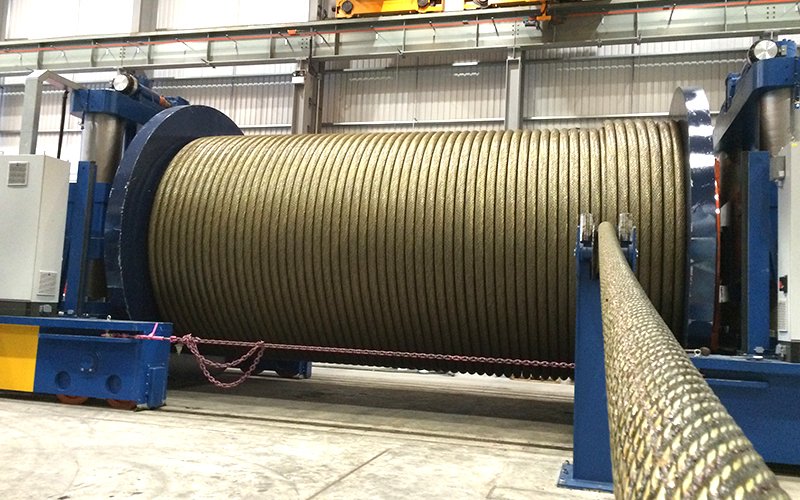
For a Singapore marine and oilfield customer we supplied 16 mm 6×36 IWRC galvanized wire rope at 1960 MPa in 2,550 metre lengths, with the mill certificate and the chemical composition report issued with the shipment. For a marine trading company we supplied 52 mm 6×36 IWRC drawn galvanized wire rope slings of 1,000 metres, a diameter well beyond standard lifting practice and firmly in the mooring and heavy tow range.
These two orders show the range. The first is a working rope for an offshore crane or winch, where the specification detail and the certificate matter. The second is large-diameter rope where the manufacturing capability and the delivery consistency are the deciding factors.
We also supply marine wire rope for anchor handling vessels, offshore crane pedestal ropes in galvanized and stainless, towing lines, and heaving lines, and we can deliver to the vessel’s port call schedule with the certificates the surveyor needs.
How Do You Order Marine Mooring Wire Rope?
Marine enquiries are specification-driven. The vessel’s class and the installation decide most of the answer.
We ask for the rope diameter and construction, the length per coil or per drum, the surface condition, the standard and class society, the termination type, the load and safety factor, and the delivery programme. We then return a specification sheet with the certificate pack and a delivery plan matched to the port call.
| Required item | Example |
|---|---|
| Rope specification | 52 mm, 6×36 IWRC, drawn galvanized |
| Strength grade | 1960 MPa |
| Length per coil | 1,000 m per coil, 2 coils |
| Surface condition | Hot-dip galvanized, plastic coated, or stainless |
| Termination | Open spelter socket, anchor pendant, or swaged with thimble |
| Standard and class | ISO 4308, with BV, ABS, DNV, or Lloyds approval |
| Load and safety factor | Breaking load and the working load limit |
| Delivery programme | Port call date and the documentation required for the surveyor |
We operate four production lines with an in-house CNAS-accredited testing laboratory, a 4000 t compression press, and a 2000 t by 800 m full-size test bed. For marine rope the full-size test bed is what allows us to prove the numbers on the certificate for a 52 mm rope rather than extrapolating from a smaller sample.
What Should You Ask a Marine Rope Supplier?
Ask the questions that reveal whether they have actually supplied marine rope before.
I recommend asking: can you provide the class society certificate, is the certificate for the finished rope or only for the wire, can you trace the certificate back to the heat number, do you proof-load the terminations, and can you deliver to a port call schedule.
The heat number question is the one that matters most. A certificate that cannot be traced back to a specific heat of steel is a certificate that a surveyor will question, because it does not prove which batch of wire went into which rope.
Send us the vessel type, the rope diameter, the standard, and the delivery date. We will return a technical proposal with the specification, the termination details, and the certificate scope.
Conclusion
We supply marine mooring wire rope by matching the construction, the corrosion protection, the termination, and the certification to the vessel, the installation, and the port call, then prove it with a full-size test and a traceable certificate pack.