A dragline rope wears out long before the steel does. The outer wires are cut by rock and coal, mud gets in, and the rope comes off the machine for a splice.
For most of the mining customers we supply, the answer is not a heavier rope. It is the same rope with a plastic sheath around it.
A plastic coated wire rope is a steel wire rope with a PVC or polyethylene sheath extruded over the finished rope. The sheath takes the abrasion instead of the outer wires, keeps coal dust and water out of the strands, and costs only about one to two percent of the breaking load against the bright rope of the same diameter.
Here is what we build, what the coating costs in load, and how to specify it.
What Is Plastic Coated Wire Rope?
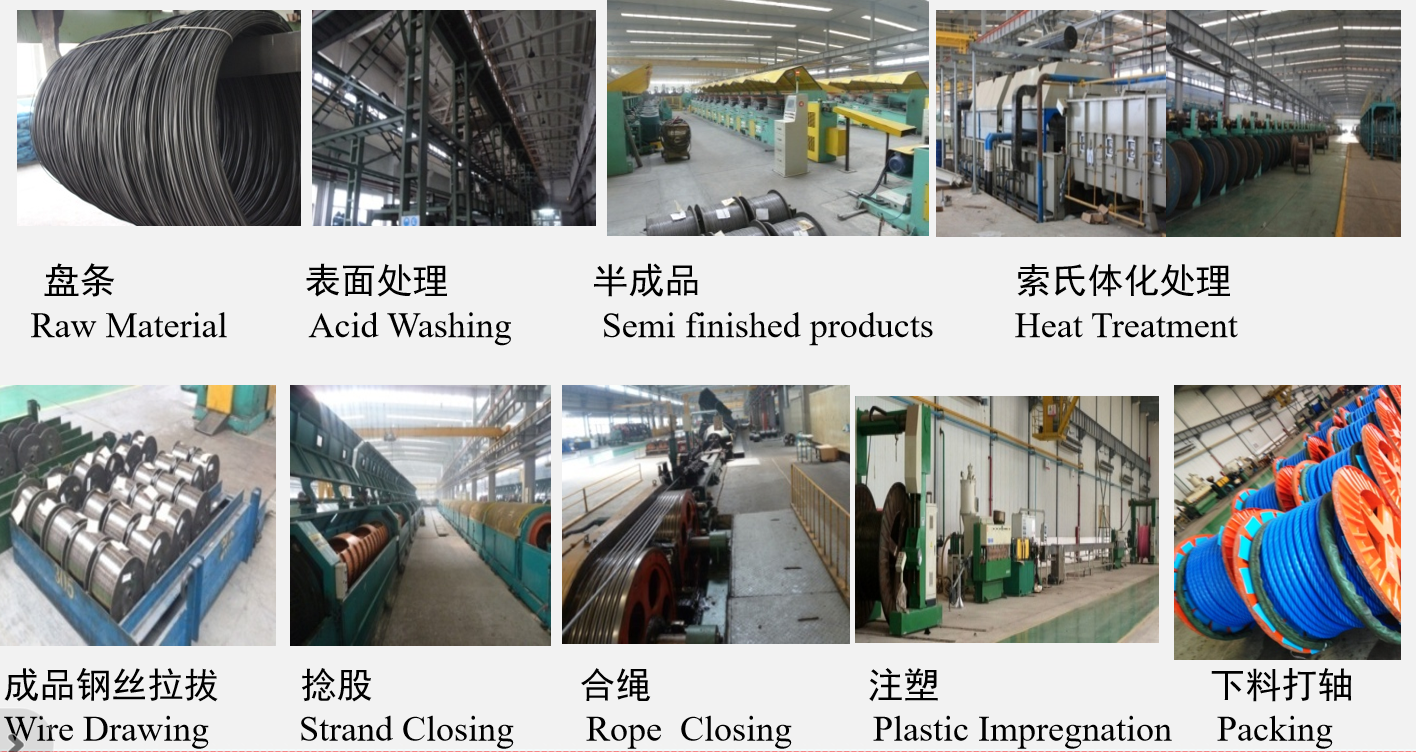
The finished rope, with all of its strands already closed, is drawn through an extruder and covered in PVC or polyethylene. All of the protection sits on the outside, where the wear is.
Plastic coated means an external sheath of PVC or PE, usually 1.5 mm to 3 mm thick, applied over a finished steel wire rope. The steel inside is neither filled nor impregnated.
A sheath removes loose broken wires and sharp steel splinters, so handling is safer. The smooth surface lowers friction on sheaves and drums. And the coating colour gives the operator a visual handle on wear.

How Is Plastic Coating Different from Plastic Impregnation?
Both use polymer and both are sold as corrosion protection, so buyers treat them as the same product. They work on different halves of the rope.
Impregnation fills the voids inside each strand and seals them. Coating wraps the whole rope in a sheath. Impregnation stops corrosion from the inside out. Coating stops abrasion and corrosion from the outside in.
| Property | Bright | PI (impregnated) | Plastic coated |
|---|---|---|---|
| Polymer location | None | Inside each strand | Around the whole rope |
| Stops | Nothing | Internal corrosion | External abrasion and corrosion |
| Breaking load | Full catalogue value | Same as bright | 1 to 2 percent below bright |
| Best fit | Dry indoor duty | Marine, chemical, drums | Mining, dragline, shovel |
A PI rope resists the water that walks into the strand, but it has no outer skin, so it does nothing against concrete or rock. We build both, and we build them together: one marine order was 35WXK7-EPIWRC at 30 mm and 42 mm, plastic impregnated and galvanized, then plastic coated.
Why Do Mining and Dragline Operations Use Coated Rope?
On surface mining equipment the rope is a wear part. It is dragged across the pit and through the spoil, and the outer wires take the damage first.
On a dragline or a shovel the rope is the sacrificial element in the system. The sheath absorbs the abrasion that would otherwise destroy the outer wires, so the rope survives longer, the machine waits less, and inspection is easier.

What our customers report back is consistent. No splinters. Less friction in sheaves and drums, so less fatigue and longer life. Resistance to dust, moisture, chemicals and temperature swings. And less cleaning, because the sheath keeps coal dust out.
A coated rope is not cheaper than a bright rope. In a dry shed it is usually not worth buying.
How Does the Coating Change the Minimum Breaking Load?
This is the number a buyer asks for first, and it is a fair question.
Only slightly. On our 8XK26WS-EPIWRC line at 2160 MPa, the minimum breaking load of the plastic coated rope is between 1.2 and 1.7 percent below the bright catalogue value at the same diameter. At 40 mm, bright is 1500 kN and coated is 1475 kN.
| Diameter | Bright MBL | Coated MBL | Difference |
|---|---|---|---|
| 16 mm | 240 kN | 236 kN | -1.6% |
| 20 mm | 375 kN | 369 kN | -1.6% |
| 24 mm | 540 kN | 531 kN | -1.6% |
| 28 mm | 735 kN | 723 kN | -1.6% |
| 32 mm | 960 kN | 944 kN | -1.6% |
| 40 mm | 1500 kN | 1475 kN | -1.6% |
The reason is physical and it is not a defect. Part of the nominal rope section is polymer and, where the wire is galvanized, zinc, and neither of them carries load. The rope measures the same diameter, but the metal taking the load is a little less.
Two rules follow. Size a coated rope from the certified value on the certificate, not from a table that assumes a bright rope. And do not assume one number covers every production run: 20 mm 8XK26WS-EPIWRC at 2160 MPa was quoted at 369 kN in one run and 354 kN in another, the second already carrying the galvanizing loss.
What Are the Real Dimensions and Loads of Large Coated Ropes?
Large coated ropes are bought by the millimetre, by the load and by the weight, and all three move together.
Here is a real series we quoted for plastic coated 8XK36WS-EPIWRC, right hand lay, at 1770 MPa. Diameter, breaking load, weight per 100 m and unit price are quoted together, and every figure in this table is traceable to that order.
| Diameter | Grade | Breaking load | Weight kg/100 m | Price RMB/m |
|---|---|---|---|---|
| 57.2 mm | 1770 MPa | 2344 kN | 1668.6 | 283.67 |
| 60.3 mm | 1770 MPa | 2627 kN | 1854.4 | 315.25 |
| 63.5 mm | 1770 MPa | 2925 kN | 2056.4 | 349.60 |
| 66.7 mm | 1770 MPa | 3193 kN | 2268.9 | 385.72 |
| 69.9 mm | 1870 MPa | 3636 kN | 2491.9 | 423.62 |
Two other coated orders on the same construction confirm the loads. A 60.3 mm rope with a plastic coated core was certified at 2641 kN, and a 60 mm galvanized version at 2614 kN. The 60.3 mm rope in the table sits at 2627 kN, right between the two.
We also cross-check against the uncoated catalogue. A 42 mm galvanized 35WXK7 with a plastic coated core was certified at 1562 kN at 2160 MPa, against 1566 kN in the published table for the same diameter and grade.
PVC or PE: Which Coating Material Should You Choose?
Both polymers work. They are chosen by environment, not by preference.
PVC is the outdoor and general purpose coating, and it is what we supply most. PE is the coating for wet, aggressive and underground environments, where chemical resistance and impact strength matter more than UV stability.
| Property | PVC | PE (polyethylene) |
|---|---|---|
| Main strength | UV resistance, outdoor durability | Chemical resistance, impact strength |
| Best environment | Above ground: dragline, shovel | Underground and wet: mine hoist |
| Chemical resistance | Good against salt, dust, coal dust | Excellent against acids and alkalis |
| Abrasion and impact | Hard skin, resists abrasion | Softer skin, absorbs knocks |
| Colour we run | Blue and orange | Blue |
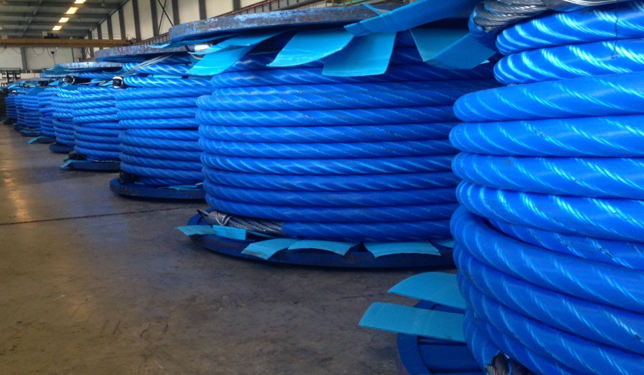
Above ground, on a dragline or a shovel, in sun, dust and coal, PVC is the right default, and the blue and orange coatings you see on our reels are PVC. Underground, in a wet shaft or a chemical plant, PE is the safer pick. PE is also better where the rope takes a hard knock, because a softer skin absorbs the impact instead of cracking.
How Thick Should the Coating Be?
The sheath is not a fixed thickness. It grows with the rope, because a big rope takes a much harder knock than a small one.
On our coated rope the sheath runs from 1.5 mm on small diameter up to 3 mm on large diameter, and the finished outside diameter is the rope diameter plus twice the coating thickness. That outside diameter is what has to clear your sheaves and your drum.
| Rope diameter | Coating thickness | Coated outside diameter |
|---|---|---|
| 16 mm | 1.5 mm | 19 mm |
| 24 mm | 2.0 mm | 28 mm |
| 30 mm | 2.5 mm | 35 mm |
| 40 mm | 3.0 mm | 46 mm |
That last point causes real problems on site. A 40 mm rope with a 3 mm sheath measures 46 mm across the outside. If the guide sheave was set for a 40 mm rope, the rope sits high in the groove and the bend radius changes. Check the outside diameter on the packing list, and give us the sheave diameters with the enquiry.
Which Core and Construction Should You Order?
The coating does not change the rope design. You choose the construction for the load path, then add the coating for the environment.
Most of the coated rope we supply for mining and heavy lifting is 8XK36WS-EPIWRC or 6XK36WS-EPIWRC with an independent wire rope core, in 1770, 1960 and 2160 MPa grades. Compacted and shaped strand constructions are also available coated.
- 8XK36WS-EPIWRC. Eight strands, flexible, high breaking force, good for multi-layer coiling.
- 6XK36WS-EPIWRC and 6XK36WS-IWRC. Six strands for six-strand machines and mine hoists.
- 35WXK7. A compacted low-rotation construction for crane and mining lift work.
- 8XK26WS-EPIWRC. Eight strands with an impregnated core, coated and usually galvanized.
The independent wire rope core is the usual choice, because it handles the crushing a heavy sheath can add to a fibre core.
What Does the Coating Do to Spooling and Terminations?
Coating changes how a rope is terminated and spooled, and both changes are mechanical.
On a coated rope the sheath is an open sleeve, so the ends must be sealed against water, and the termination must be made so the sheath cannot creep. We use pressed button fittings and swaged sockets, and on large coated rope the button is the usual choice.
One of our coated orders was 8XK36WS-EPIWRC, plastic coated core, 60.3 mm at 1770 MPa, with a button fitted at each end and supplied as 105.23 m reels. A second order was the galvanized 60 mm version in 60 m reels. The fitting has to be specified for the coated rope and pressed to the rope, not clamped onto the sheath.
On spooling, calculate drum capacity on the outside diameter, not on the steel diameter. A coated rope still needs some lubrication, because the coating reduces internal friction but does not remove it.
What Standards Does a Coated Rope Meet?
Coating is a finishing process applied to a rope that is already certified. That is why the certificate matters.
The rope is built to the relevant standard, normally EN 12385 or ISO 2408 depending on the construction, and the coating is applied afterwards. The certificate you receive is the rope certificate with the coated finish recorded on it.
We have supplied coated rope on an EN 12385-4 basis at 1370 MPa grade in 25 mm and 38.5 mm diameters, in a single 50 t order totalling more than 10,000 m. Our checks cover coating uniformity and adhesion, lubrication of the inner rope, and salt and dust resistance testing.
How Do You Inspect a Coated Rope in Service?
The coating hides the wires, and it can hide a defect under a scuff.
Inspect the coating itself. A coated rope is judged by the condition of the sheath: look for cuts, crushing, peeling and exposed steel at the ends, and check the rope under every guide sheave. If the sheath is intact, the wires under it are almost always intact too.
- Check the sheath along the whole working length. Cuts and abrasion marks show where the rope is rubbing.
- Look at the ends closely. That is where water enters, and where a coated rope fails first.
- Keep the rope clean. Coal dust and grit trapped under the sheath wear it from the outside.
- Check sheave and guide diameters against the coated outside diameter, and never run the rope over a sharp edge.
How Do You Order Coated Rope from Us?
Coated rope is not a catalogue line you order by diameter alone. The construction, grade, core, coating, thickness and termination all have to line up with the machine.
Send us the drawings and the load cases. We will return a technical proposal with the construction, the grade, the coating material and thickness, the certified breaking load, the reeling plan and the delivery time, together with the mill certificate for the lot.
These are real coated ropes we have quoted and supplied.
| Construction and finish | Diameter | Grade | Breaking load | Quantity |
|---|---|---|---|---|
| 8×36WS+IWRC, PVC coated | 75 mm | 1770 MPa | 3445 kN | 500 m |
| 8XK36WS-EPIWRC, coated core | 60.3 mm | 1770 MPa | 2641 kN | 6313.8 m |
| 8XK36WS-EPIWRC, coated, galvanized | 60 mm | 1770 MPa | 2614 kN | 3600 m |
| EP8XK36WS-IWRC, coated | 60.3 mm | 1770 MPa | 2627 kN | 400 m |
| 35WXK7, galvanized, coated core | 42 mm | 2160 MPa | 1562 kN | 4500 m |
| 6XK36WS-EPIWRC, coated, EN 12385-4 | 25 and 38.5 mm | 1370 MPa | On certificate | 50 t |
| 8XK26WS-EPIWRC, coated, galvanized | 20 mm | 2160 MPa | 354 kN | 1000 m |
| 10XK26WS-EPIWRC, coated | 20 mm | 2160 MPa | 390 kN | 1000 m |
The 60.3 mm and 60 mm rows are the same construction and grade with and without galvanizing. The 20 mm rows show why strand count matters: the ten strand rope is certified about 10 percent higher than the eight strand rope.
Conclusion
Plastic coated wire rope is the simplest way to protect a steel rope from the outside. It survives rock, coal, mud, salt and chemicals, it is safer to handle, and it gives the operator a visible surface to inspect.
It costs about one to two percent of breaking load against the bright rope of the same diameter, and it adds three to six millimetres to the outside diameter. Both are on the mill certificate and the packing list.
If you are choosing between a bright, a galvanized and a coated rope for a dragline, a shovel or an underground hoist, send us the drawings and the load cases. We will tell you plainly if a coated rope is not right for that machine.