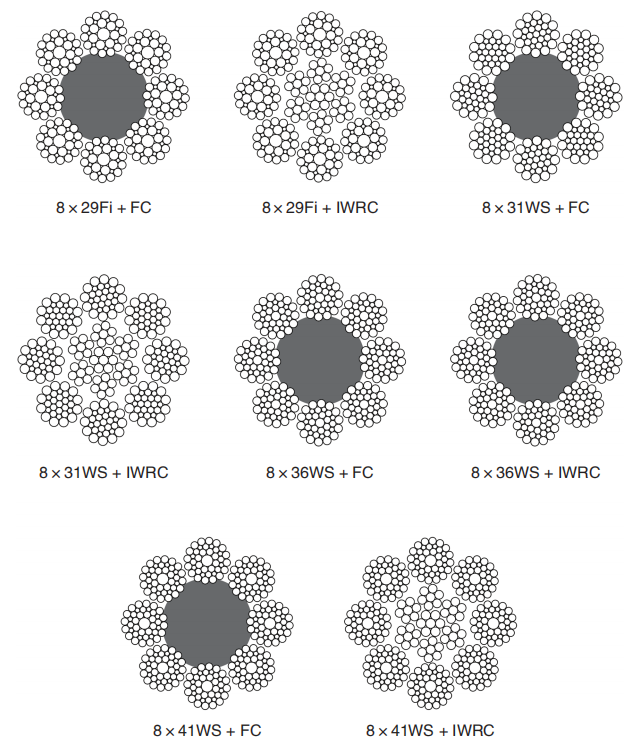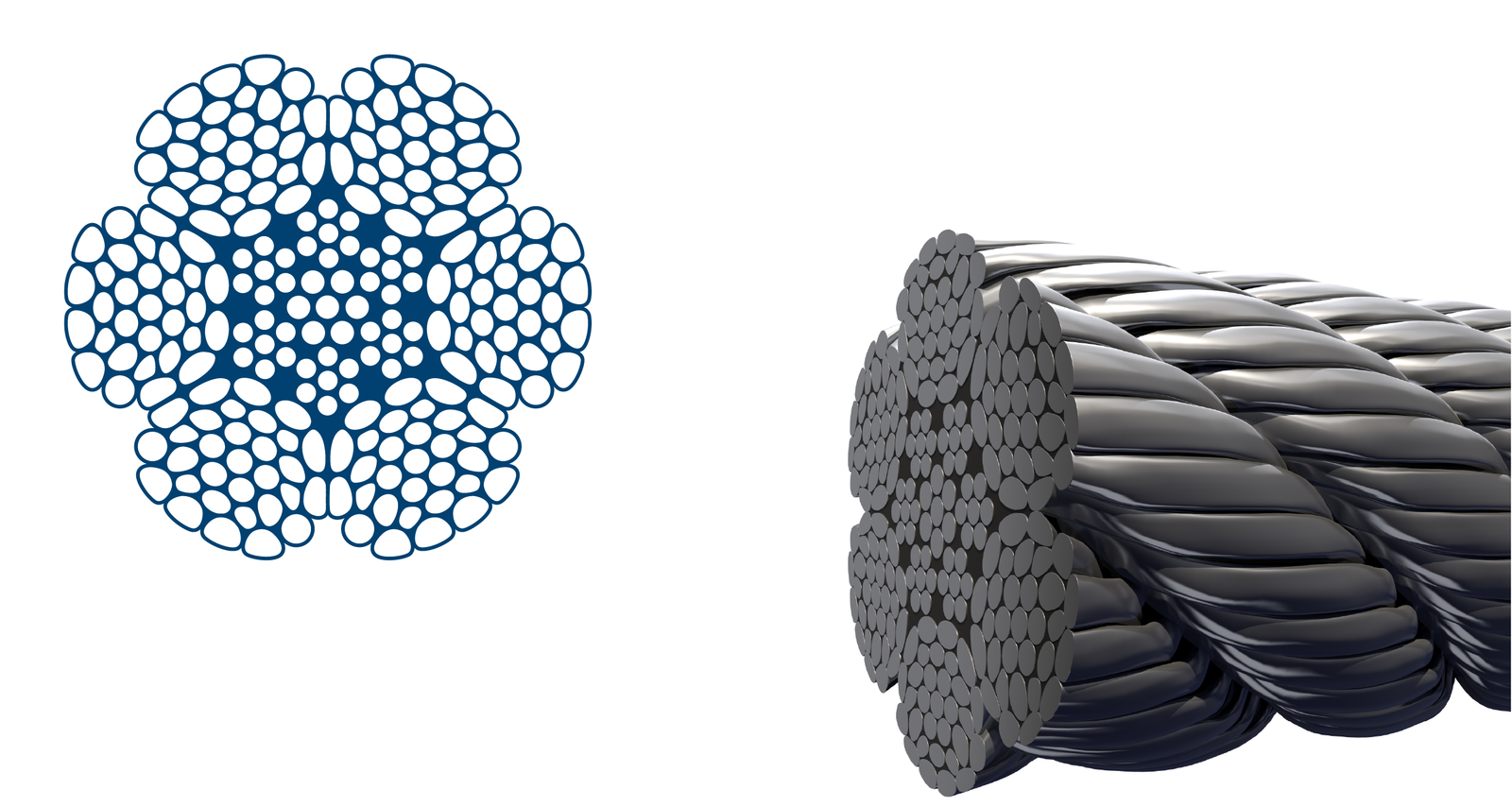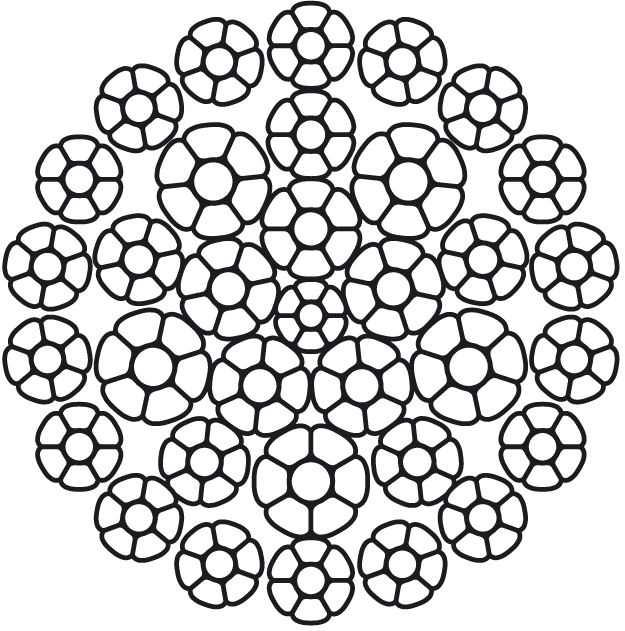
A compacted wire rope looks like a normal rope until you cut it open. The wires inside are flat. That single manufacturing step changes what the rope can carry, and it changes what it costs to move.
A compacted strand wire rope is a rope whose wires are mechanically compressed after stranding, so the same diameter carries about 24 percent more breaking load than a standard round strand rope of the same construction. We make it in 6XK36WS, 35WXK7, 24WXK7, 18XK7-FC, and other configurations.
For a buyer, this means a straightforward decision. If the drum, the sheave, or the installation is already fixed and you cannot change the diameter, compaction is how you get more capacity out of the space you have. If the diameter is free, the comparison is more nuanced, and it is worth understanding why before you specify.

What Is a Compacted Strand Wire Rope?
The definition is short, but the consequences are not.
We manufacture a compacted rope by passing each finished strand through a mechanical press that flattens the individual wires and packs them tightly together. The wires lose their natural round cross-section, the voids between them shrink, and the rope gains roughly 24 percent more breaking load at the same nominal diameter.
Three things change at once when the wires are flattened.
- More steel fits into the same diameter, so the breaking load rises.
- The outer surface becomes smooth and slightly smaller, so wear on the rope and on the sheave both drop.
- The wires are locked against each other, so internal movement falls, and bending fatigue life improves.
The tradeoff is flexibility. A compacted rope is stiffer than a round strand rope of the same diameter, because the flattened wires cannot slide past each other as easily. This matters when the rope has to bend around a small sheave, and it is the single most important question to ask before specifying a compacted rope.
How Much More Load Does a Compacted Rope Carry?
This is the number that drives most purchase decisions, so we want to give you the real figures rather than a general claim.
Comparing our compacted 6XK36WS-IWRC against our standard 6X36WS-IWRC of the same diameter and the same strength grade, the compacted rope carries about 24 percent more minimum breaking load at the same nominal diameter.
| Diameter | Compacted 6XK36WS weight kg/100m | Round strand 6X36WS weight kg/100m | Compacted MBL kN at 1770 MPa | Round strand MBL kN at 1770 MPa | Load difference |
|---|---|---|---|---|---|
| 8 mm | 30 | 24.3 | 46 | 37.4 | +23.0% |
| 11 mm | 57 | 46.0 | 88 | 70.7 | +24.5% |
| 14 mm | 92 | 74.5 | 142 | 114 | +24.6% |
| 16 mm | 120 | 97.3 | 186 | 150 | +24.0% |
| 18 mm | 152 | 123.0 | 235 | 189 | +24.3% |
| 20 mm | 188 | 152.0 | 290 | 234 | +23.9% |
| 22 mm | 227 | 184.0 | 351 | 283 | +24.0% |
The percentages hold almost exactly across the whole diameter range. That consistency is the signature of a real manufacturing process rather than a marketing figure.
There is another way to read this data. Back-calculating from the breaking load, a compacted rope reaches roughly 52 percent metal fill against about 42 percent for a round strand rope. Every point of fill is steel that was previously wasted as space.
Which Compacted Rope Configurations Do We Supply?
Compaction is a process, not a product. It applies to many constructions.
We supply compacted strand wire rope in 6XK36WS, 35WXK7, 24WXK7, and 18XK7-FC, with an independent wire rope core or a fiber core, in 1770, 1960, and 2160 MPa grades, and with galvanized, plastic impregnated, or bright finish.
| Configuration | Wires per strand | Characteristics | Typical application |
|---|---|---|---|
| 6XK36WS-IWRC | 36 | High strength, good fatigue life, IWRC crush resistance | Mine hoists, friction winders, heavy lifting |
| 35WXK7 | 35 | Low rotational, high tensile strength, good abrasion resistance | Tower cranes, truck cranes, drilling rigs |
| 24WXK7 | 24 | Compacted and rotation resistant, compact diameter | Constrained installations, tower cranes |
| 18XK7-FC | 18 | Fiber core, high flexibility and shock absorption | Lower-capacity lifts needing good bending |
Our 35WXK7 deserves a specific mention. It is a compacted, low-rotation construction with an expanded contact surface on the sheave, and it has become the standard rope for tower cranes, truck cranes, and rotary drilling rigs. The rotation-resistant design matters on a crane because a rope that spins under load twists the load and destabilizes the lift.
How Does Compaction Affect the Rope Surface?
This is where compaction earns its keep over time, and it is the part most people notice last.
We rely on the compacted surface to reduce wear on both the rope and the sheave, because the flattened outer wires present a continuous bearing surface instead of a row of round crowns. In service this shows up as a longer rope life and a longer sheave life at the same time.
The mechanism is straightforward. A round strand rope contacts the sheave at a series of points, one per wire. Each contact point carries a local pressure that grows as the rope bends. The wire material at that point carries the full load while the material beside it carries almost nothing, so fatigue cracking starts at the contact and works inward.
A compacted rope distributes this differently. The flattened outer wires sit against the sheave across their full width. The contact area is larger, the pressure per unit area is lower, and the load spreads across more of the wire section.
For an operation running ropes over large drums at high cycle counts, this is the difference between a rope that lasts its rated life and one that does not.
What Does Compaction Do to Fatigue Life?
Fatigue is what actually ends most ropes, and compaction affects it in a way that is often misunderstood.
Compaction reduces internal wire movement, which reduces the bending stress that each wire sees at every reversal. This improves fatigue life, but the improvement depends on how the rope is used. A compacted rope on a large-drum, low-cycle application will show less benefit than the same rope on a small sheave at high cycle.
There is a second effect. Because the wires are locked together, a broken wire does not unwind the strand. The rope keeps its shape and keeps working. On a high-cycle application this changes the failure pattern from sudden and catastrophic to gradual and detectable, which is a major safety improvement in practice.
The same locking effect is why we recommend checking the minimum sheave diameter for a compacted rope before specifying it. A compacted rope needs a larger sheave than a round strand rope of the same diameter, because it cannot bend as sharply.
Where Is Compacted Rope Used?
The applications follow from the properties.
We use compacted wire rope where the load is high, the cycles are many, the drum space is fixed, and the sheave diameter is known to be adequate. In practice this means crawler and truck cranes, tower cranes, mine hoists and friction winders, dragline and shovel hoisting, and elevators.
| Application | What compaction delivers | Point to check |
|---|---|---|
| Tower cranes | More capacity per diameter, less wear on the sheave, low rotation | Sheave diameter against the construction requirement |
| Truck and crawler cranes | Higher breaking load in the drum space available | Drum capacity and the number of falls |
| Mine hoisting | Better fatigue life under cyclic loading, higher capacity | Minimum sheave or wheel diameter |
| Friction winders | More load per rope, smoother surface on the wheel | Wheel groove and rope diameter tolerance |
| Dragline and shovel | Higher capacity, reduced drum wear | Drum spooling and the rope-to-sheave ratio |
| Elevators | Lower stretch, smoother ride, long fatigue life | Traction sheave diameter and the traction ratio |
How Does Compacted Rope Compare with Standard Wire Rope?
A direct comparison is useful, and it is also where buyers most often get confused.
We choose compacted rope when the diameter is fixed, the cycles are high, or the drum and sheave wear is a measurable cost. We choose standard round strand rope when the sheave diameter is small, the cycles are low, or the budget is the deciding factor.
| Property | Standard round strand | Compacted strand |
|---|---|---|
| Metal fill | About 42 percent | About 52 percent |
| Breaking load at the same diameter | Standard | About 24 percent higher |
| Weight at the same diameter | Lower | About 23 percent higher |
| Flexibility | Higher, bends around smaller sheaves | Lower, needs a larger minimum sheave |
| Abrasion resistance | Standard | Better |
| Fatigue resistance | Standard | Improved |
| Stretch under load | Higher | Lower |
| Spooling on multilayer drums | Moderate | Excellent dimensional stability |
| Surface smoothness | Normal | Smoother, less friction against sheaves |
Note the weight line. A compacted rope is heavier than a round strand rope of the same diameter, because it contains more steel. The gain is not weight saving. The gain is capacity in a fixed space.
Should You Choose Compacted Rope for Your Application?
Five questions decide it, and we ask all of them before we recommend a construction.
We confirm the diameter is fixed, the sheave or drum diameter is adequate, the cycle count is high enough to justify the premium, the drum space is tight, and the sheave wear is a real cost. If the answer to most of these is no, a standard rope is usually the better choice.
| Question | If the answer is yes | If the answer is no |
|---|---|---|
| Is the rope diameter already fixed by the machine? | Compaction adds capacity without changing the machine | You can compare diameters directly instead |
| Is the minimum sheave or wheel diameter large enough? | Compaction is safe to specify | Stay with round strand or a more flexible construction |
| Does the rope see many cycles per day? | The fatigue and surface benefits pay off | The premium buys less than it costs |
| Is drum or sheave wear measured as a cost? | Reduced wear on both is a real saving | Weigh the premium against the rope cost alone |
| Is the installation space constrained? | Maximum capacity per diameter | Space is not the constraint, so capacity is not the driver |
How Do You Order Compacted Wire Rope?
The order needs the machine details, not just the diameter.
We ask for the rope construction, the diameter, the strength grade, the length per drum or coil, the number of ropes, the drum and sheave dimensions, the cycle count, and the certification. With the machine information we can confirm the minimum sheave diameter and the safety factor properly.
| Required item | Example |
|---|---|
| Construction | 6XK36WS-IWRC, 35WXK7, 24WXK7 |
| Diameter and strength grade | 20 mm, 1960 MPa |
| Length per drum and quantity | 350 m per drum, 4 ropes |
| Drum and sheave dimensions | Drum diameter, groove type, sheave diameter |
| Surface condition | Hot-dip galvanized, plastic impregnated, or bright |
| Certification | EN 12385-4, with BV, ABS, DNV, or RMRS if required |
| Delivery | Length per reel and the packing method for sea freight |
We operate four production lines, and we keep stock on the common compacted constructions such as 15XK7, 35WXK7, 24WXK7, and 18XK7-FC. Standard sizes usually ship quickly. Non-standard items are made to order against your specification.
What Should You Ask a Compacted Rope Supplier?
Ask the questions that reveal whether the supplier actually compacts the rope rather than simply selling a heavier one.
I recommend asking: what is the metal fill figure, can you show the breaking load against a standard rope at the same diameter, what is the minimum sheave diameter for the construction, is the compression done in-house, and what does the test certificate cover.
The first question is the most revealing. A supplier who can state the fill factor has done the calculation. A supplier who cannot is quoting from a catalogue.
The minimum sheave diameter question is the most important for safety. We supply compacted rope to EN 12385-4 and EN 12385-10, and we confirm the minimum sheave and drum dimensions with the machine data before we release the order.
Send us the construction, the diameter, the load, and the drum and sheave dimensions. We will return a technical recommendation with the supporting parameter data.
Conclusion
We choose compacted strand wire rope when a fixed diameter, a high cycle count, and a tight drum make capacity per millimetre the deciding factor, and we confirm the minimum sheave diameter before we build it.