Ask for “6×36 wire rope” and you have not specified a rope. You have named a family. Two machines carrying the same name can still fail for opposite reasons: one from crushing against the drum, the other from bending fatigue at the sheave.
We recommend choosing between 6×19, 6×36, 6×37 and 8-strand construction by matching the number of wires per strand to the bending cycle, then confirming the core type, the strength grade and the minimum breaking load against the working load. At the same diameter, our steel-core reference figures for 6-strand and 8-strand rope sit close together, so the real decision is driven by flexibility, fatigue life and wear rather than by headline strength.
Here is how each family behaves, using our own parameter tables.
What Do the Numbers in 6×19 or 8×19 Actually Mean?
Construction names look like multiplication, but they describe a physical arrangement.
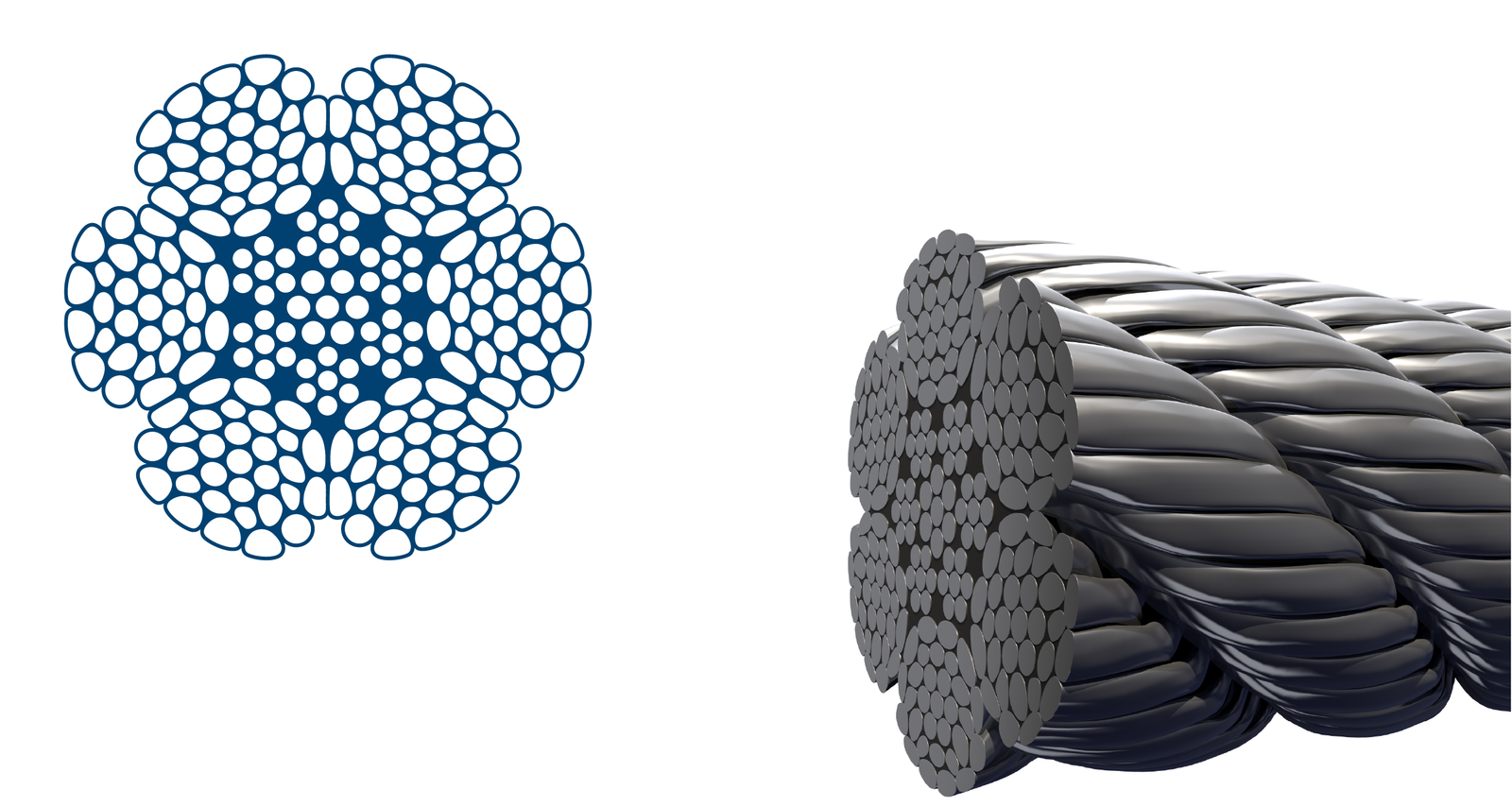
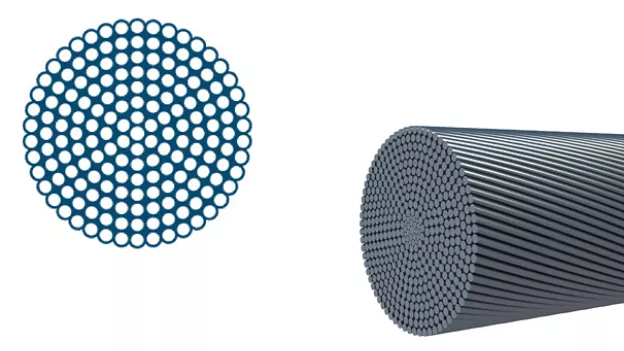
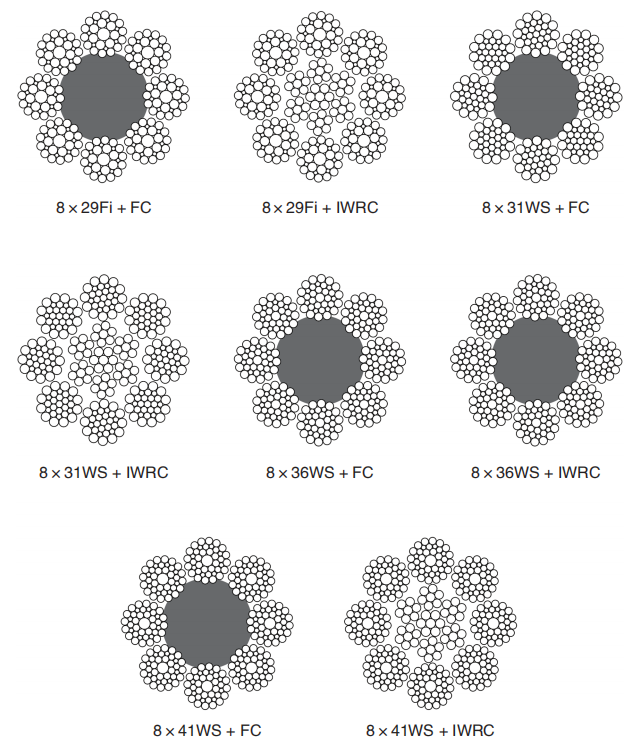
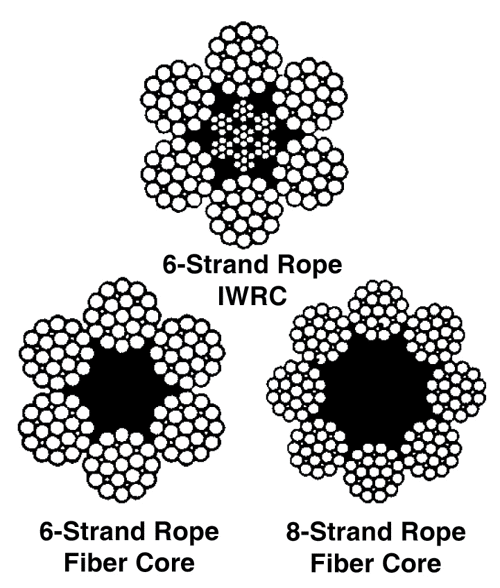
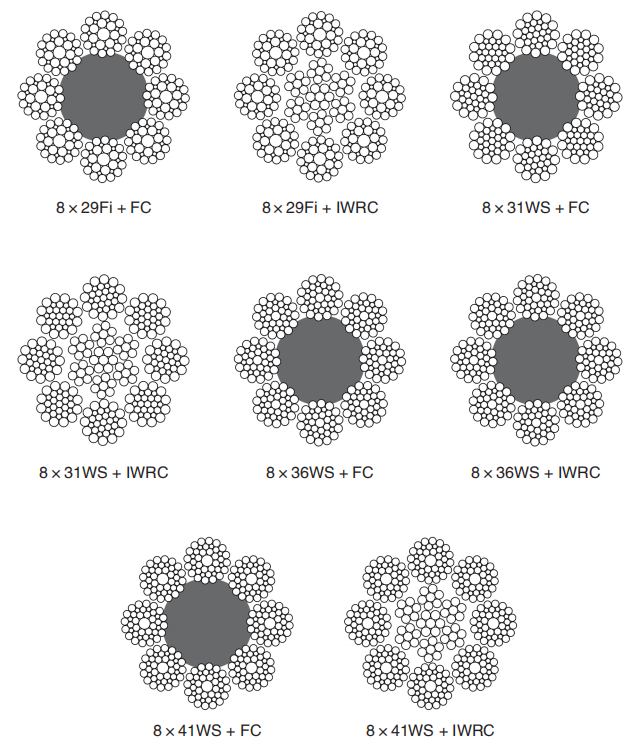
The first number is the outer strands. The second is the wires inside each strand. The rope also has a core, and the core is not counted in either number. So 6×19 means six strands of nineteen wires each, laid around a core that can be fiber or steel.
| Family | Strands and wires | Common constructions | Character | Typical use |
|---|---|---|---|---|
| 6×19 class | 6 strands, 19 to 26 wires each | 6×19S, 6×19W, 6×25F, 6×26WS | Abrasion and compression resistance | Abrasive drums, general lifting |
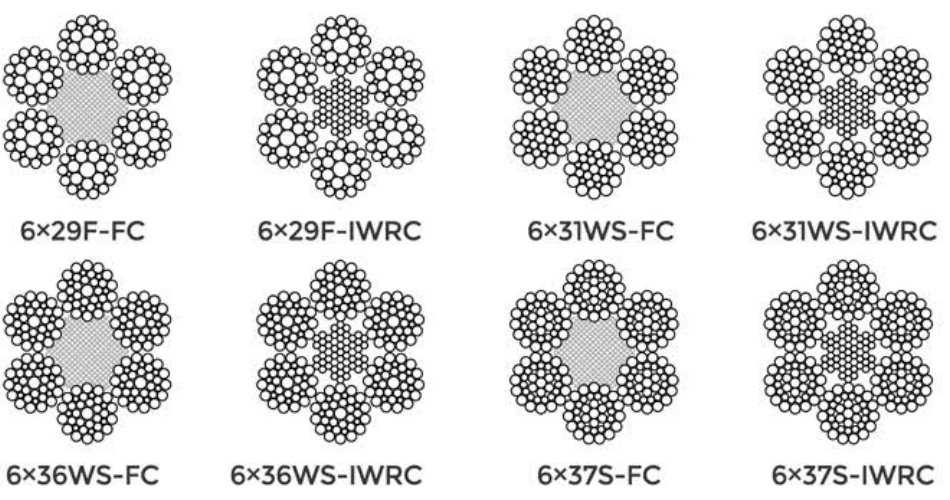
| 6×36 class | 6 strands, 29 to 49 wires each | 6×29F1, 6×31WS, 6×36WS, 6×41WS, 6×49WS | Fatigue resistance and flexibility | High cycle winches, cranes, elevators |
| 6×37 | 6 strands, 37 wires each | Flexible end of the six-strand family | High flexibility and fatigue life | High bending cycle service, small sheaves |
| 8×19 class | 8 strands, 19 to 26 wires each | 8×19S, 8×19W, 8×25F, 8×26WS | Better flexibility and fatigue than 6-strand | Offshore luffing, trolley traction |
| 8×36 class | 8 strands, 29 to 41 wires each | 8×29F1, 8×31WS, 8×36WS, 8×41WS | Maximum flexibility in the 8-strand range | Small sheaves, continuous spooling |
How Do 6×19, 6×36 and 6×37 Differ From Each Other?
Inside the six-strand family, the deciding factor is how many wires sit in each strand.
More wires per strand means more flexibility and better fatigue life, but less abrasion resistance and less resistance to crushing. Fewer, larger wires give better surface wear resistance and better drum performance. That single rule explains almost every difference you will see between a 6×19 and a 6×36 rope.
We say this in our own catalogue notes, for every class. Our 6×19 class ropes are described as having excellent abrasion and compression resistance; our 6×36 class ropes as having excellent fatigue resistance. Same diameter, same core, same grade, but a completely different behaviour under a sheave.
How Does an 8-Strand Rope Differ From a 6-Strand Rope?
The extra two strands change the behaviour of the rope without changing its diameter.
Our catalogue states that 8×19 class line contact wire ropes offer better flexibility and fatigue resistance than similar 6-strand constructions. That is the main reason to specify eight strands over six, and it is a bending advantage, not a strength advantage.
The strength picture is closer than most buyers expect. In our class reference tables the steel-core minimum breaking force at 1770 MPa is 161 kN at 16 mm for both the six-strand and eight-strand classes, and 567 kN against 551 kN at 30 mm. Fiber-core figures are lower for eight strands, because less of the cross section is left for fiber: at 16 mm the reference figure is 150 kN for the 6×19 class and 133 kN for the 8×19 class.
| Diameter | 6×19 class weight (kg/m) | 6×19 class MBL at 1770 MPa | 8×19 class weight (kg/m) | 8×19 class MBL at 1770 MPa |
|---|---|---|---|---|
| 16 mm | 0.993 fiber / 1.091 steel | 150 fiber / 161 steel | 0.89 fiber / 1.142 steel | 133 fiber / 161 steel |
| 24 mm | 2.235 fiber / 2.454 steel | 336 fiber / 363 steel | 1.99 fiber / 2.569 steel | 299 fiber / 363 steel |
| 40 mm | 6.208 fiber / 6.816 steel | 935 fiber / 1008 steel | 5.54 fiber / 7.136 steel | 830 fiber / 1008 steel |
One caution. A single layer of eight strands is still a single layer, and it will rotate under load over a single sheave with a fixed dead end. For rotation resistance you need a multi-strand construction.
When Should You Use a 6×19 Class Rope?
Choose six-strand, nineteen-wire class rope when the drum is abrasive and the bending cycle is moderate.
We use the 6×19 class for drum applications where surface wear and drum pressure dominate: cranes, winches, hoists, drag systems, logging equipment, towing equipment and general industrial lifting. The larger outer wires tolerate abrasive drums and repeated spooling better than any more flexible six-strand construction.
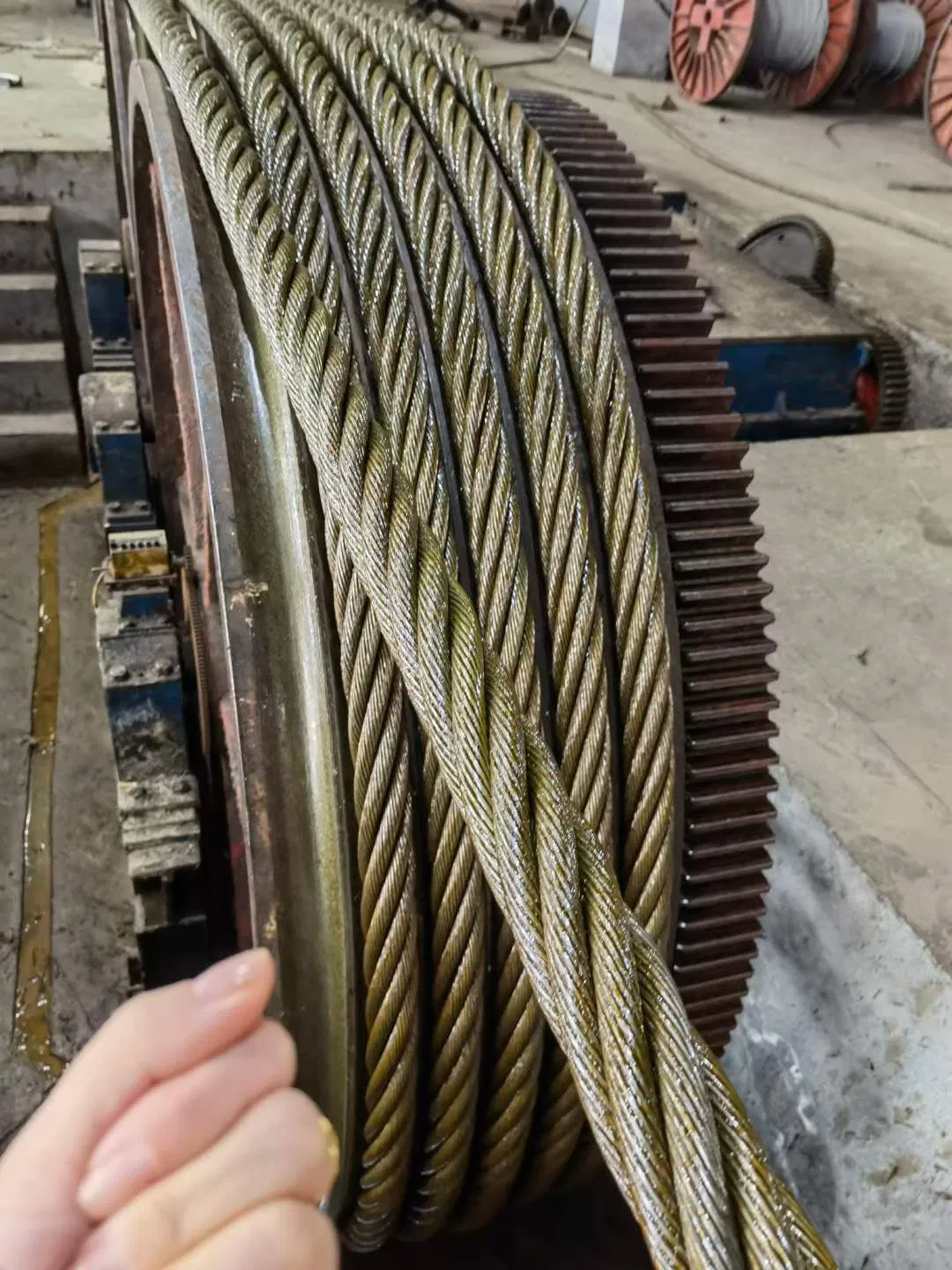
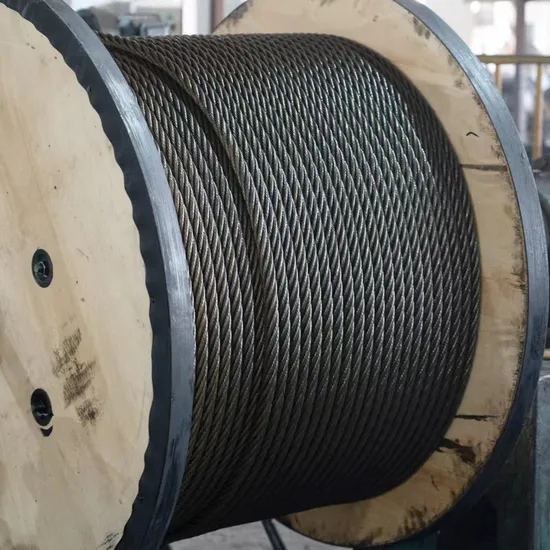
It is also the family we see most often in our own order book. A typical order is 6XS(19)+FC in 1770 MPa, hot-dip and drawn galvanized with a zinc coating above 100 g, supplied on 500 m and 1000 m reels from 14 mm to 24 mm. The minimum breaking forces on that order line are 114 kN at 14 mm, 150 kN at 16 mm, 189 kN at 18 mm, 234 kN at 20 mm, 283 kN at 22 mm and 336 kN at 24 mm, matching our published table line for line.
When Should You Use a 6×36 Class Rope?
Choose six-strand, thirty-six-wire class rope when the bending cycle is high and the sheaves are small.
We use the 6×36 class for cranes, elevators, offshore platform cranes, ship-to-shore container cranes, drilling rigs and high-cycle winches, where the rope spends most of its life bending over a sheave. The higher wire count per strand is what carries the fatigue life.
Our six-strand parameter sheet covers this family from 8 mm to 80 mm. At 1770 MPa the steel-core minimum breaking force runs from 40.3 kN at 8 mm to 2270 kN at 60 mm, and the 1960 MPa column from 44.7 kN to 2510 kN.
| Diameter | Weight (kg/100m) | MBL at 1770 MPa | MBL at 1960 MPa | MBL at 2160 MPa |
|---|---|---|---|---|
| 8 mm | 26.8 steel core | 40.3 | 44.7 | 49.2 |
| 16 mm | 107 steel core | 161 | 179 | 197 |
| 30 mm | 376 steel core | 567 | 628 | 692 |
| 40 mm | 669 steel core | 1010 | 1120 | 1230 |
| 60 mm | 1500 steel core | 2270 | 2510 | 2770 |
Use 6×19 when wear is the enemy. Use 6×36 when fatigue is the enemy.
When Does 6×37 Fit Into This?
6×37 sits at the flexible end of the six-strand family, one wire per strand above 6×36.
We supply 6×37 as part of our six-strand range for service where the bending cycle is high and the drum pressure is low. On the same wire-count rule, 6×37 gives slightly more flexibility and fatigue life than 6×36, and slightly less abrasion and crush resistance.
On our round strand product page we list 6×19, 6×36 and 6×37 together as the six-strand constructions for general lifting and hoisting, and 8×19 and 8×36 as the eight-strand constructions for heavier loads and specialised duties. Because 6×37 is quoted against the same six-strand reference data as 6×36, confirm the exact breaking load for your diameter and grade before you order.
When Should You Use an 8-Strand Rope?
Choose eight strands when flexibility and fatigue life matter more than the last few percent of breaking load.
We recommend 8-strand construction for offshore and marine crane luffing ropes, trolley traction ropes and oil and gas platform luffing duty, where our recommendation chart specifies 8XK26WS-EPIWRC, and for machines that were designed around an eight-strand rope from the start.
Eight strands carry the load over more, smaller wires, so the rope bends around a smaller sheave with lower stress per wire. We have supplied 38 mm 8×26WS+IWRC in galvanized compacted plastic impregnated finish at 2160 MPa with a minimum breaking force of 1278 kN, in both left-hand and right-hand ordinary lay.
Should You Choose a Fiber Core or a Steel Core?
The core changes the strength, the stiffness and the temperature behaviour of the rope.
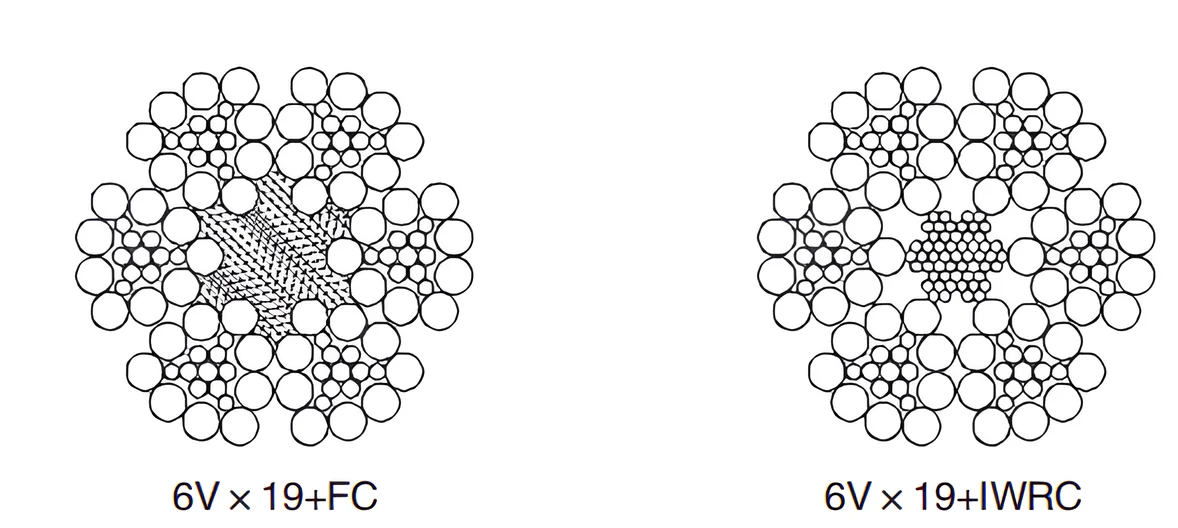
We specify an independent wire rope core where the rope is exposed to crushing, high temperature or heavy load, and a fiber core where maximum flexibility and shock absorption matter more than the extra strength. At 16 mm and 1770 MPa our six-strand reference figures are 150 kN with a fiber core and 161 kN with a steel core, and our 8×26WS figures are 150 kN and 188 kN.
Our catalogue puts it plainly: wire ropes with steel cores perform better than those with fiber cores, and line contact ropes are recommended where compression resistance has to be improved, because of their larger metallic cross-sectional area. Fiber core, from natural fibers such as sisal or manila or from synthetic fibers, stores lubricant and absorbs shock. Steel core gives higher strength and far better crush resistance.
| Selection point | Fiber core | Steel core (IWRC) |
|---|---|---|
| Flexibility | Highest | Lower |
| Breaking load at equal diameter | Lower | Higher |
| Resistance to drum crushing | Poor | Good |
| High temperature duty | Limited | More suitable |
| Lubricant storage | Good | Depends on core design |
| Typical use | Ship unloader hoisting, general lifting | Cranes, offshore, drilling, mooring |
We also add plastic impregnation to either core where the rope cannot be re-lubricated on schedule. Filling the core with polymer keeps lubricant inside and reduces internal wear, which makes it the right answer for marine and mining service.
Does Compaction Change the Numbers?
Compaction changes how much steel sits inside a given diameter, and that changes the breaking load.
We use compacted strand construction when the machine has a fixed drum size and the rope has to deliver more strength in the same diameter. Our six-strand 6X36WS sheet gives 161 kN at 16 mm and 1770 MPa with a steel core, while our compacted 6XK36WS-IWRC sheet gives 186 kN at the same diameter and grade, and our 8X26WS steel-core figure of 188 kN rises to 197 kN in the compacted plastic impregnated 8XK26WS-EPIWRC version.
Compaction flattens the wires slightly after the rope is formed. The strands pack closer, the internal voids disappear, and the metallic cross section per strand goes up. The result is a smaller diameter at the same strength, a smoother surface that is easier on sheaves and drums, and a higher breaking load at a given diameter. Our compacted strand product page notes that compacted ropes can be made in 6×19, 6×36 or 8×19 configurations.
How Do Strength Grade, Diameter and Lay Change the Answer?
Three variables sit on top of the construction choice, and one decides most outcomes on its own.
Diameter is the strongest lever on breaking load, then strength grade, then core type. The grade raises the breaking load in step with the tensile strength of the wire, and the lay direction changes how the rope behaves under rotation and spooling rather than how much it carries.
Look at our eight-strand parameter sheet at 20 mm. At 1770 MPa the fiber core gives 234 kN and the steel core 294 kN. At 1960 MPa the same rope gives 259 kN and 325 kN. At 2160 MPa it gives 285 kN and 359 kN. Moving from 1770 to 2160 MPa buys roughly a fifth more strength, while moving from 16 mm to 24 mm roughly doubles it.
Lay is the quiet variable. Right-hand ordinary lay and left-hand ordinary lay are the two normal choices, with right-hand lang lay used where you need more resistance to untwisting and better spooling on a multi-layer drum. Our ordering information lists lay direction as RHRL, RHLL, LHOL and LHLL.
What Do We Need From You to Quote the Right Rope?
Enquiries with only a construction name take longer and carry more risk.
We ask for the nominal diameter, the construction, the core type, the strength grade, the surface condition, the length per coil or reel, the lay direction, the working load with its safety factor, and the delivery programme. Give us those and we return a specification sheet with the certified figures.
| Item we need | Example answer |
|---|---|
| Nominal diameter | 20 mm |
| Construction | 6×36WS, 8×26WS or 6XK36WS |
| Core | Fiber core or independent wire rope core |
| Strength grade | 1770, 1960 or 2160 MPa |
| Surface condition | Bright, hot-dip galvanized, or plastic impregnated |
| Lay direction | Right-hand ordinary lay or left-hand ordinary lay |
| Length | 1000 m per coil, two coils |
| Load and safety factor | Working load and the required breaking load |
| Certification | Test certificate, and any class or third-party approval |
For reference, one recent order in our 6X36WS fiber core range covered 27 mm right lay and left lay at 10,000 m each, 33 mm right lay and left lay at 1,000 m each, and 42 mm right lay and left lay at 1,000 m each. That is why we ask for lay direction explicitly: on a 10,000 m length, left lay and right lay are different products.
What Should You Check Before the Rope Goes On the Drum?
Four checks catch most problems before the rope is paid for and installed.
Check the drum and sheave geometry against the construction, check the groove type, confirm the lay direction against the machine, and confirm the rope length against the drum capacity in layers. A rope that is one diameter too large for the sheaves will lose its fatigue life long before it reaches its breaking load.
The geometry check is the one people skip. A more flexible construction such as 8×19 or 6×37 needs a larger sheave diameter than a 6×19 to survive the same cycle count, and a 6×19 on a sheave sized for a 6×36 will wear out early.
On the grooving side, our catalogue notes that the smooth surface of line contact wire ropes reduces friction between the sheaves and the rope surface, which minimises wear on both rope and sheave. That benefit only works if the sheave profile matches the rope.
Conclusion
We select round strand wire rope by matching the wires per strand to the bending cycle, the core to the crushing and temperature conditions, the grade and diameter to the load, and the lay to the machine. Six-strand rope wins on abrasion and compression resistance, eight-strand rope wins on flexibility and fatigue life, and the reference breaking forces at a given diameter are closer than most buyers expect.
Send us the diameter, the construction, the core, the grade, the surface condition, the lay direction and the length, plus the working load and the safety factor. We will return a technical proposal with the certified minimum breaking load and the recommended sheave dimensions.