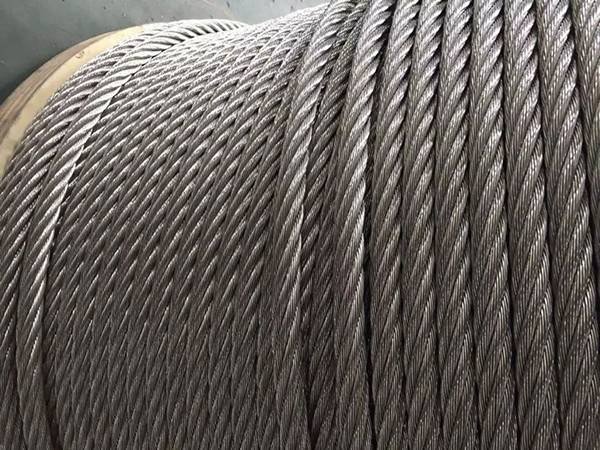
Coal mines run on wire rope. Every cage, every hoist, every conveyor, every longwall roof support depends on it. A rope that fails in a coal mine does not just stop a shift. It can stop the whole mine.
Coal mining wire rope must handle moisture, coal dust, abrasion, shock loading, and long service cycles in one package. We select it by the duty it performs, the shaft conditions it faces, and the load it must carry.
I have seen mine maintenance teams treat a hoist rope and a conveyor rope as the same product. They are not. One hangs a cage with people in it. The other pulls coal through a tunnel. The working conditions, the failure modes, and the inspection rules are completely different.
What Makes Coal Mining Wire Rope Different from Other Mining Rope?
Surface mining and underground coal mining put very different demands on the same steel.
We use underground coal rope when the rope works in a wet shaft with coal dust, and surface mining rope when the rope works on a dragline, shovel, or stacker in an open pit. The construction changes because the environment changes.
A dragline rope runs in daylight with a clean drum. An underground hoist rope works in a shaft where water falls on it and coal dust works into every gap. The second rope needs more protection from the same steel cross-section.
There are five conditions that decide coal mining rope selection. They are moisture, abrasion, shock, corrosion, and how long the rope must stay in service. We work through all five before we discuss diameter.
What Are the Main Coal Mine Rope Duties?
A coal mine uses several different ropes. Each one has a different job and a different failure risk.
We match the rope to the duty: shaft hoisting for cages and skips, man-riding and guide ropes for cage guidance, friction winder ropes for inclined shafts, conveyor and scraper ropes for material movement, and longwall and dragline ropes for production faces.
| Coal mine duty | What the rope does | Main demand on the rope |
|---|---|---|
| Shaft hoisting | Lifts the cage and skip through the shaft | High breaking load, fatigue resistance, consistent diameter |
| Friction winder | Pulls the cage on an incline | Flexibility, high strength-to-weight ratio, wear resistance |
| Guide rope | Keeps the cage aligned in the shaft | Stiffness, stable diameter, wear resistance |
| Conveyor and scraper | Moves coal and material along the tunnel | Abrasion resistance, moisture protection |
| Longwall and roadheader | Supports and moves cutting equipment | Shock resistance, fatigue life, corrosion protection |
| Dragline and shovel | Handles overburden and coal at the face | Very high breaking load, crush resistance, drum wear control |
When a buyer sends us only a diameter, we always ask which of these six duties it is. The answer changes the recommendation completely.
How Do You Choose a Rope for Underground Coal Shaft Hoisting?
Underground hoisting is the most safety-critical rope duty in coal mining. The rope carries the cage, the skip, sometimes the people, and it must not fail.
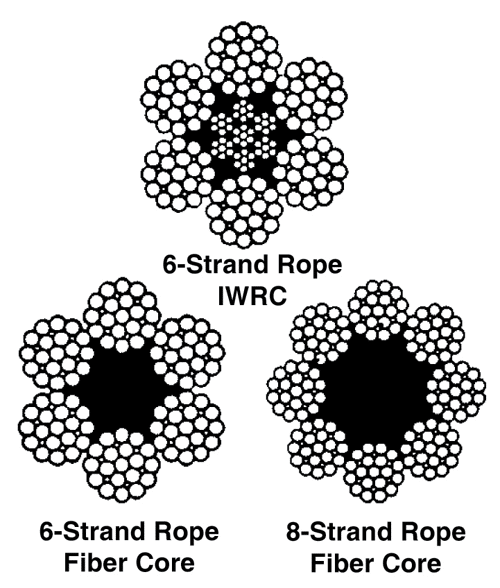
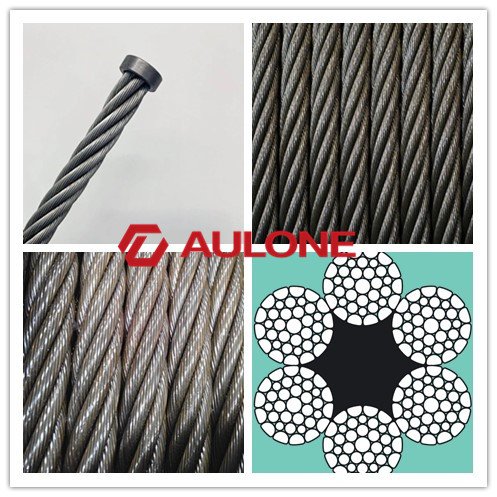
For underground shaft hoisting we normally recommend a compacted strand rope with an independent wire rope core, in 6XK36WS or 8XK36WS construction, with plastic impregnation when the shaft is wet. The compaction gives the breaking load, and the impregnation keeps water and coal dust out of the core.
Here is why each part matters.
Why Compaction?
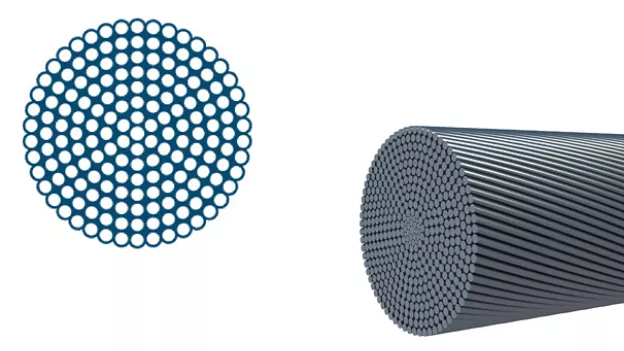
Compaction flattens the wires after stranding. This packs more steel into the same diameter. The rope gets more breaking load without growing larger, and the surface gets smoother, which reduces wear on the drum and the sheaves.
In a mine shaft, the rope bends over the sheave on every trip. A rougher rope surface means more wear on both the rope and the sheave. Compaction reduces that wear directly.
Why an Independent Wire Rope Core?
An independent wire rope core is a small wire rope inside the main rope. It adds roughly seven to ten percent more strength compared with a fiber core. It also resists crushing, which matters when the rope is tensioned hard against a drum groove or a clamp.
For vertical hoisting over long distances, we also pay attention to rotation. A rope that twists under load makes the cage swing and can damage the guide rope. Non-rotating constructions are the right answer when the shaft is deep and the load is unbalanced.
Why Plastic Impregnation?
Plastic impregnation fills the gaps between wires and between strands with a polymer. It does two useful things. It locks the lubricant in place so it stays available for the life of the rope. It also blocks water and coal dust from entering the core.
Wet shafts are the reason. I have seen rope that looked fine on the surface and was corroded through the core after two years underground. Impregnation is not a luxury in a wet coal shaft. It is the difference between a rope that is inspected and a rope that is replaced.
Which Rope Construction Works Best for a Coal Mine Friction Winder?
A friction winder works differently from a drum winder. The rope sits on the wheel and the friction between rope and wheel does the driving. That puts a bending cycle on the rope at every trip, whether the cage moves or not.
For coal mine friction winders we usually specify 6X36WS-FC or 6XK36WS-FC. The fiber core gives the flexibility the wheel demands, and the 36-wire strand carries the load with good fatigue life.
Some mines use the compacted version. Compacted 6XK36WS-FC gives more strength at the same diameter, which lets the operator reduce the rope size or keep the same size and carry more. The trade-off is slightly lower flexibility. We confirm the minimum sheave diameter with the mine before we commit to a compacted construction.
The table below shows the difference in minimum breaking load between a standard and a compacted 6X36WS rope.
| Diameter | Weight kg/100m | MBL kN at 1770 MPa | MBL kN at 1960 MPa | MBL kN at 2160 MPa |
|---|---|---|---|---|
| 8 mm | 30 | 46 | 51 | 57 |
| 11 mm | 57 | 88 | 97 | 107 |
| 13 mm | 79 | 123 | 136 | 150 |
| 16 mm | 120 | 186 | 206 | 227 |
| 18 mm | 152 | 235 | 260 | 287 |
| 20 mm | 188 | 290 | 321 | 354 |
The strength grade matters as much as the diameter. We normally suggest at least 2160 MPa for new deep hoisting installations and 1770 or 1960 MPa where the installation is older and the drum geometry limits the diameter.
How Does Coal Dust and Water Change the Rope Surface Decision?
This is where most coal rope orders go wrong. A buyer specifies bright rope because it is cheaper, and then the rope sits in a wet shaft for two years.
For underground coal we normally recommend galvanized or plastic impregnated rope, and we add a plastic coating when the rope faces heavy abrasion or long exposure to water. Hot-dip galvanized wire gives the base protection, and the polymer keeps the water out.
We apply one rule from our own workshop. If the wire is hot-dip galvanized, we do not add oil on top, because oil trapped against a zinc coating can attack the zinc layer. If the wire is bright, we oil it. This is not a small detail. It is the difference between a coating that protects and a coating that fails early.
| Surface condition | Base protection | Oil or grease | Best fit in coal mining |
|---|---|---|---|
| Bright, ungalvanized | None | Yes, lubricated | Dry, indoor, short-term applications |
| Hot-dip galvanized | Zinc layer | No | Outdoor, wet shaft, general mine service |
| Plastic impregnated | Zinc plus polymer in the core | No, polymer carries lubrication | Wet underground shaft, high corrosion risk |
| Plastic coated | Full polymer sheath over the rope | No | Heavy abrasion, dragline and shovel, drag chains |
What Rope Do Coal Mine Longwall and Roadheader Operations Need?
Longwall and roadheader faces are the harshest underground environment. The equipment runs wet, the roof falls, and the rope sees shock loads every time a section collapses or the shearer hits coal.
For longwall and roadheader work we recommend plastic impregnated rope with high fatigue resistance, and we advise the mine to check the rope against shock loading rather than static load only.
Static breaking load tells you nothing about shock performance. A rope that passes a static test can still fail under a dynamic load, because the individual wires see a very different force distribution when the load arrives suddenly. We look at ductility, reverse bending, and torsion rather than only the headline number.
For the coal cutter itself, we look at the same criteria plus the sheave diameter. A small sheave with a stiff rope will break wires in the core.
How Do You Choose Wire Rope for a Coal Mine Dragline?
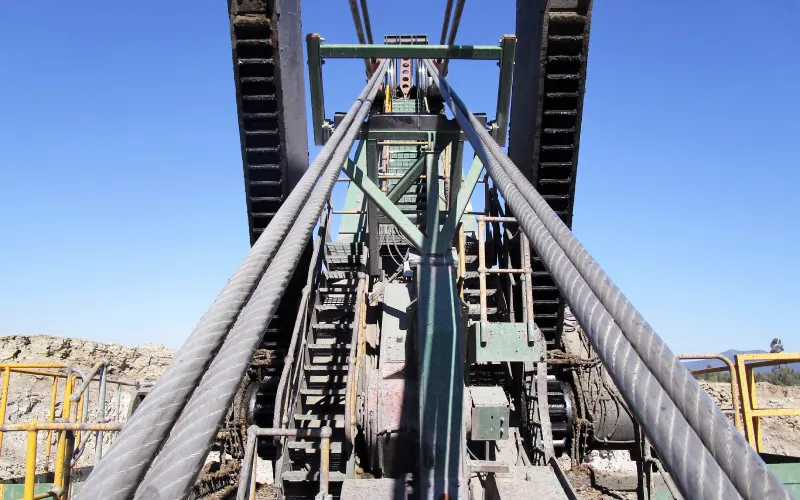
Surface coal operations run the largest ropes we make. A dragline boom hoist rope can be over 100 mm in diameter and carry hundreds of tonnes.
For dragline and shovel hoisting we use 8-strand plastic impregnated rope such as EP8XK36WS-IWRC, and 6-strand EP6XK36WS-IWRC for electric shovel hoists. The eight-strand layout handles bending fatigue better, and the six-strand compacted layout gives more strength in a smaller diameter.
The eight-strand design matters because it distributes the load over more wires around the drum. The plastic impregnation reduces internal friction, which directly reduces drum wear and rope wear. Both reduce the cost of the rope and the cost of the machine.
We also confirm the rope-to-sheave diameter ratio. Running a rope on a sheave that is too small is the most common cause of early failure we see in surface mining. The D/d ratio is not negotiable.
What Certifications Should a Coal Mine Rope Supplier Provide?
Mines are audited. The supplier’s paperwork is part of the audit.
We supply EN 12385-4 compliant rope as standard, and we can arrange BV, CE, RMRS, DNV, or ABS certification when the mine and the inspection scope require it. We also provide mill certificates, wire test results, and inspection photographs.
What a coal mine usually asks for in the documentation pack:
| Document | What it proves |
|---|---|
| EN 12385-4 compliance | The rope meets the European safety standard for steel wire ropes |
| Mill test certificate | The steel chemistry and mechanical properties of the wire |
| Breaking load test | The actual measured minimum breaking load of the finished rope |
| Coating test report | Zinc or polymer coating weight and adhesion |
| Third-party certificate | BV, CE, RMRS, DNV, or ABS verification |
| Inspection photographs | The actual product and packing before dispatch |
We also welcome third-party inspection. Many coal mine customers prefer an independent surveyor at the factory rather than only our own test report. We arrange this as a normal part of the order.
How Do You Inspect and Maintain Coal Mining Wire Rope?
Selection decides half the service life. Inspection decides the other half.
We recommend a fixed inspection schedule tied to rope duty: daily visual checks on all ropes, weekly detailed checks on hoisting ropes, lubrication on the mine’s own schedule, and a full record for every discard decision.
The things that end a coal rope in service are predictable. Broken wires at a wear point. Corrosion under a coating that was damaged in handling. Reduction in diameter from wear. Birdcaging or core protrusion from over-winding. None of these appear suddenly, so the inspection record is what tells you the truth.
Two field practices cause more failures than any fault in the rope itself. The first is cross-laying on the drum during spooling. The second is letting the rope sit on wet ground in the mine yard. Both are avoidable and both are common.
How Do You Set a Safe Working Load for Coal Mining Rope?
Safety factor selection is where I see the most inconsistency between mines, and it is worth getting right because the same rope runs on different equipment across the site.
We do not use one safety factor for the whole mine. We set it by duty and follow the applicable standard: hoisting and man-riding applications run at the strict end, while static duties such as a scraper conveyor or a boom stay run at the other end.
| Duty | Typical safety factor | What drives it |
|---|---|---|
| Man-riding and cage hoisting | Highest, per the governing standard | People depend on it directly |
| Machine hoisting, skips, and auxiliary hoists | High | Suspended load over people and equipment |
| Friction winder rope | High, matched to the wheel design | Continuous bending and dynamic load |
| Dragline and shovel hoist | Medium to high | Shock load from the bucket and swing |
| Conveyor, scraper, and stationary runs | Lower | Static load with low consequence |
We use the standard calculation as a starting point, then check it against the actual rope diameter, the sheave diameter, the drum groove, and the number of falls. A rope that satisfies the safety factor on paper can still be the wrong answer for the machine it goes into.
How Do You Know When to Replace a Coal Mine Rope?
Replacement decisions should be based on measured condition, not on a calendar and not on opinion.
We replace the rope when the discard criteria in the governing standard are reached, and we document the measurement that triggered it. We never advise a mine to keep a rope running because the previous one lasted two years.
Typical discard triggers we see in coal operations:
- Broken wires reaching the discard count for the rope construction
- Corrosion visible in the core or under a damaged coating
- Diameter reduction beyond the limit for the nominal diameter
- Any visible deformation, including core protrusion or birdcaging
- Damage at the termination, socket, or clamping point
- Loss of lubrication combined with visible wear
The last point is the one that surprises people. A rope can be inside every numeric discard criterion and still be ready to fail, because a dry rope generates heat and galling long before the wire count changes.
How Do You Order Coal Mining Wire Rope From A Supplier?
A clear order saves weeks and prevents the wrong rope arriving at the mine gate.
We ask for the duty, the load, the drum or wheel dimensions, the rope length per reel or per drum, the number of ropes, the required certification, and the delivery date. With those seven items we can confirm availability and quote accurately.
Here is the minimum information we need for a coal mine order:
| Required item | Example |
|---|---|
| Duty | Shaft hoisting, friction winder, dragline hoist, conveyor |
| Nominal diameter | 22 mm |
| Construction | 6XK36WS-IWRC, 35WXK7, EP8XK36WS-IWRC |
| Strength grade | 1960 MPa |
| Surface condition | Hot-dip galvanized, plastic impregnated, or plastic coated |
| Length and quantity | 1200 m per drum, 4 ropes |
| Certification | EN 12385-4, plus BV or RMRS if required |
| Drum and sheave dimensions | Drum diameter, sheave diameter, groove type |
We operate four production lines and keep stock on the common mining constructions, so standard sizes usually ship quickly. Non-standard items are made to order. In every case we confirm the specification in writing before production starts.
What Should You Ask a Coal Mining Wire Rope Manufacturer?
Before you place an order, ask the questions that reveal whether the supplier understands your mine.
I recommend asking: which construction do you recommend for this duty and why, what evidence supports it, what certification can you provide, what is the lead time, what does the test documentation include, and what happens if the rope fails in service.
The last question matters most. A supplier with real field experience will tell you how their rope behaves in a specific condition. A supplier without it will only restate the catalogue.
We are happy to answer these questions with data. Send us the duty, the load, the drum dimensions, and the shaft conditions, and we will return a technical recommendation with the supporting test information.
Conclusion
We choose coal mining wire rope by matching the construction, surface protection, strength grade, and certification to the actual mine duty, then keep it alive through inspection, lubrication, and honest discard decisions.